As we write this market commentary the US Federal Government recently ended a 40+-day shutdown due to a budgetary stalemate in Congress. As a result, many government workers were sitting at home while “essential” employees did their jobs without the benefit of paychecks. For several weeks, the U.S. House of Representatives was in shutdown mode as well. Interestingly, the continuing resolution (CR) that ultimately passed and opened the government featured a new provision for the governance of hemp-derived THC, which is explained by a November 13th report by Cannabis Business Daily:
“…hemp-derived cannabinoid products will be federally illegal starting Nov. 13, 2026, if they contain:
- cannabinoids that are synthesized or manufactured outside the plant (delta-8 THC);
- cannabinoids that are not capable of being naturally produced by the plant (HHC)
- more than 0.3% total THC (including THCA) or other cannabinoids with similar effects; or
- more than 0.4 milligrams of total THC per container.”
We predict that this move by Senate Republicans which was ultimately signed into law might not be the final word on intoxicating hemp, so stay tuned as this plays out at the state level.
In the month of October Cannabis-linked equities remained in a holding pattern, as the clock ticks for balance sheet debt that was raised at inflated interest rates. This is largely debt that will need to be refinanced (possibly at higher rates) in the next twelve months.
At this point in time the often thinly-traded cannabis market lays dormant (but not flat) while the US government tugs at its heartstrings, repeatedly, offering investors hope that some relief is on the way, in the form of rescheduling, “SAFE” banking, or perhaps federal legalization. But the headwinds created by Washington as well as the illicit market never seem to fully subside, the most notable of which being the emergence of a growing market for intoxicating hemp products, as we have referenced above.
In October 2025, cannabis equities ended the month with a fizzle, with no continued support for the rally that we saw at the end of September. This should have been no surprise to investors given the ongoing government shutdown. So while crickets chirped in Washington, cannabis stocks languished without any good news to prop them up this time around.
As we have done for nearly a decade, CRB Monitor provides not only the gold standard in cannabis and digital asset-linked market intelligence, but also the insights that stakeholders have found essential for their daily investment operations. As such, we will keep abreast of the relevant news out of Washington D.C., the states, and globally, to ensure that no critical information seeps through the cracks.

Cannabis-Linked Equity Performance
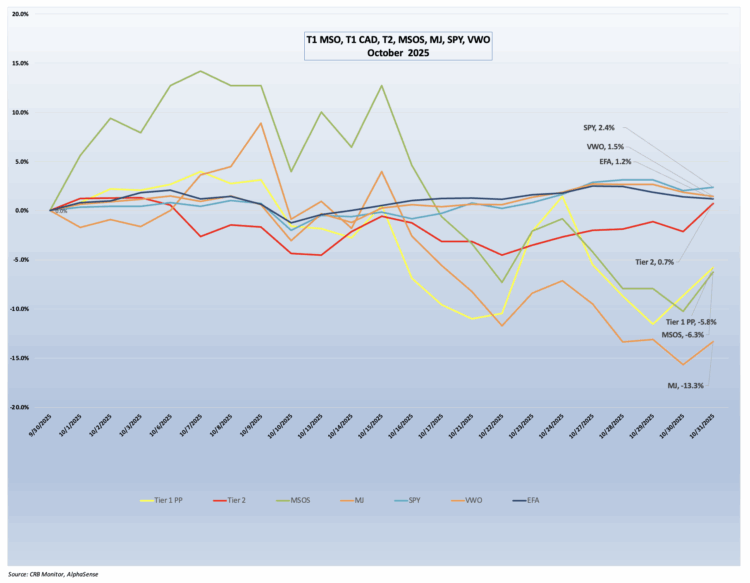
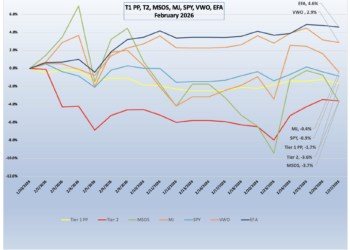
Performance was negative for the two largest US plant-touching cannabis-themed ETFs, the Amplify Alternative Harvest ETF (NYSE Arca: MJ) (-13.3%) and the actively-managed MSO-heavy Advisorshares Pure US Cannabis ETF (NYSE: MSOS) (-6.3%). These funds (and other cannabis-themed ETFs) had a volatile October before closing lower for the month. Both of these funds are benchmarked to pure play CRB-themed indexes, and while they use different construction methodologies, their returns will be directionally close to each other. It’s worth mentioning that these funds are not considered Controlled Substances Act (CSA)-friendly, as they both carry exposure to US plant-touching marijuana businesses.
The CRB Monitor equally-weighted basket of top Pure Play Tier 1 CRBs also reversed course in October, returning -5.8%. This portfolio is an equally-weighted basket of the largest pure play Ther 1 CRBs (representing both US plant-touching and non-US plant-touching MJ companies).
The CRB Monitor equally-weighted basket of Tier 2 CRBs outperformed the Tier 1 CRB basket, posting a +0.7% return for October 2025. In August 2025 CRB Monitor published an update to our article on correlations of Pure Play Tier 1 and Tier 2 CRBs, as well as correlations of MSO and Canadian operators. And what we have observed historically is that these two groups tend to display high correlation (~0.50) in the long term, while their respective performance has a tendency to diverge in the short term. This can be due to (among other factors) the lag from the impact of market forces (for example, marijuana rescheduling) that affect their sources of revenue that are derived from the Tier 1 group.
In October 2025 U.S. equities led by the S&P 500, enjoyed another positive month, marking its sixth consecutive monthly gain. A number of tailwinds underpinned this advance: strong corporate earnings (with the S&P 500 companies posting year-over-year growth of about 10.7% for Q3), continued enthusiasm around now heavily-weighted artificial intelligence and technology stocks, and the Federal Reserve’s rate-cut decision which reinforced positive investor sentiment. With that said, the US market was not without its disappointments: value stocks and mid-caps lagged behind, and market breadth showed signs of strain.
The S&P 500 (represented by the SPDR S&P 500 ETF Trust (NYSE Arca: SPY)) posted a return of +2.4% for the month of October.
Largest Tier 1 Pure Play & Tier 2 CRBs by Market Cap – October 2025 Returns
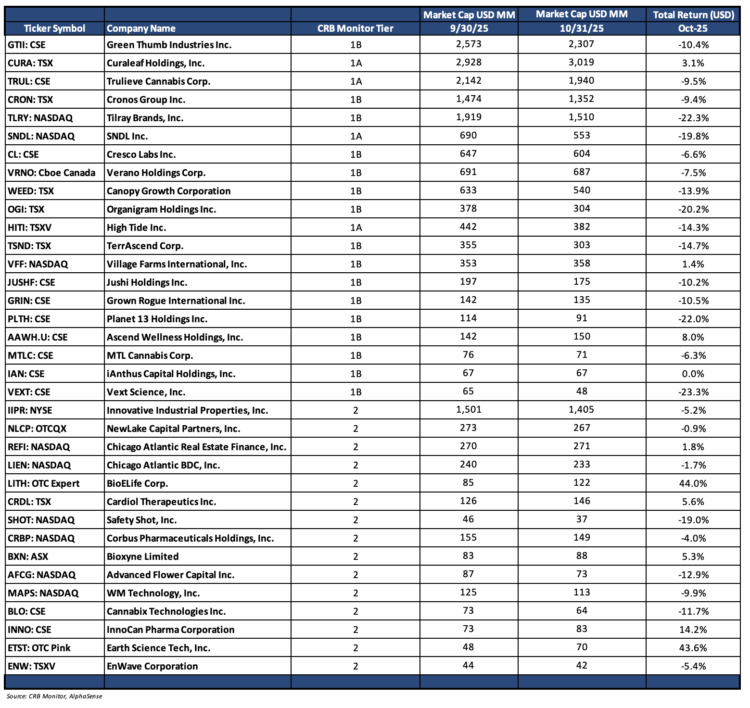
An equally-weighted basket of the largest Tier 1 pure-play cannabis equities (a combination of MSO and CAD companies) had its difficulties in October, with mixed but mostly negative returns across the board. Tier 1 CRBs underperformed the Tier 2 basket by around 6%.
CRB Monitor Tier 1
October 2025 CRB performance of Tier 1 cannabis equities continued the 2-month slump following August’s meteoric returns, with many of the companies closing out the month in the red. The MSO basket struggled with several CRBs closing out the month in double-digit negative territory. Tier 1A MSO Trulieve Cannabis Corp. (CSE: TRUL) (-9.5%), Tier 1B Cresco Labs Inc. (CSE: CL) (-6.6%), Tier 1B Verano Holdings Corp. (CSE: VRNO) (-7.5%), and Tier 1B TerrAscend Corp. (TSX: TSND) (-14.7%) slumped ahead of early November earnings reports. The largest CRB by market cap, Green Thumb Industries Inc. (CSE: GTII) (-10.4%) also suffered. One notable exception was Curaleaf Holdings, Inc. (CSE: CURA) (+3.1%) which eked out a positive return in October.
The Canadian CRB basket generally underperformed the MSOs in October. Tier 1B CRB Canopy Growth Corporation (TSX: WEED) (-13.9%) gave back nearly all of its September gains, while Tier 1B craft beverage giant Tilray Brands, Inc. (Nasdaq: TLRY) (-22.3%) delivered a crushing blow to its investors. Tier 1A SNDL, Inc. (Nasdaq: SNDL) (-19.8%), Tier 1B High Tide Inc. (TSXV: HITI) (-14.3%) and Tier 1B Cronos Group Inc. (TSX: CRON) (-9.5%) also took back any positive returns from the prior month. There’s no question about it: “Sellers gonna sell” when there isn’t much to be optimistic about.
As we have stated regarding these two groups (MSOs and CADs), short-term performance has deviated between the CAD and the MSO baskets, but they tend to mean-revert over time and historical correlations are high. It is also worth mentioning that as an industry cannabis has fallen to the point where no company’s stock can even be regarded as a small capitalization stock; over the last few years they have all shrunk (some by more than 90%) to the point where they are considered micro-caps and effectively non-investable by most institutions from a policy perspective. For more detail on the MSO/CAD relationship, please see our August Chart of the Month on our CRB Monitor News website.
CRB Monitor Tier 2
An equally-weighted basket of the largest CRB Monitor Tier 2 companies outperformed the Tier 1 basket in October 2025, posting a return of +0.7%. Historically the performance of these two portfolios (given their close business ties) has displayed high correlation (please see our recently-published August 2025 “Chart of the Month”), and we expect the returns of Tier 1 and Tier 2 CRBs to mean-revert over time. When the two baskets deviate from one another in the short term, the deviation could be a signal for investors to rebalance into (out of) the Tier 1 basket and out of (into) Tier 2’s given their direct revenue relationship. This is due to the fact that Tier 2 CRBs are direct suppliers of goods and services to (and derive their revenues from) Tier 1 CRBs. However, the precise moment when these two baskets mean revert is not easy to predict and the costs required to systematically rebalance these illiquid portfolios could eat up any expected material gains from even the best rebalance strategy. In other words, gaming these two baskets can lead to losses, so proceed with caution!
The performance of the largest CRB in the Tier 2 basket, well-known REIT Innovative Industrial Properties, Inc. (NYSE: IIPR) (CRBM Sector: Real Estate) (-5.2%) was negative for the second month in a row following a strong August. On October 15th IIPR declared its quarterly dividend (required by law) of 7.5%. IIPR’s 3rd quarter 2025 earnings report, which featured the following highlights:
- Total revenues of $64.7 million and net income attributable to common stockholders of $28.3 million, or $0.97 per share (all per share amounts in this press release are reported on a diluted basis unless otherwise noted).
- Adjusted funds from operations (“AFFO”) and normalized funds from operations (“Normalized FFO”) of $48.3 million and $45.2 million, respectively.
- Paid a quarterly dividend of $1.90 per common share on October 15, 2025 to stockholders of record as of September 30, 2025. Since its inception, IIP has paid over $1.0 billion in common stock dividends to its stockholders.
Tier 2 REIT Advanced Flower Capital, Inc. (Nasdaq: AFCG) (CRBM Sector: Real Estate) (-12.9%) struggled for the second month in a row, underperforming the overall Tier 2 group. Q3 earnings have not been reported, but on August 13th AFCG reported its 2nd Quarter 2025 earnings of $6.3 million which featured the following eye-opening statement from CEO Daniel Neville, which emulates the actions of AFCG’s peer Chicago Atlantic (Nasdaq: REFI):
“AFC also announced today its intention to seek to convert from a commercial mortgage real estate investment trust (“REIT”) to a business development company (“BDC”), subject to shareholder approval of certain related matters. If approved, the conversion will enable the Company to pursue a broader array of investment opportunities, including both real estate- and non-real estate-related assets.
“The proposed conversion to a BDC marks an important milestone in AFC’s trajectory,” said Dan Neville, CEO, adding “Given the capital-intensive nature of the cannabis industry, combined with the high cost of capital, many operators do not own real estate, which significantly limits the universe of cannabis operators AFC can lend to as a mortgage REIT. Converting to a BDC would significantly expand our investable universe, allowing us to lend to ancillary cannabis businesses with high growth potential, as well as non-real estate covered, vertically integrated operators.””
Tier 2 technology company, WM Technology, Inc. (Nasdaq: MAPS), operates Weedmaps, the leading online listings marketplace for cannabis consumers and businesses, and WM Business, the most comprehensive SaaS subscription offering sold to cannabis retailers and brands. Following a an August rally, WM Technology’s stock came back to earth with a -6.5% return. On November 6th, MAPS reported its 3rd Quarter 2025 earnings, with the following headlines:
- Revenues for the second quarter ended June 30, 2025 were $44.8 million as compared to $45.9 million in the prior year period
- Net income increased to $2.2 million as compared to $1.2 million in the prior year period.
- Adjusted EBITDA(3) increased to $11.7 million from $10.1 million in the prior year period.
- Total shares outstanding across Class A and Class V Common Stock were 156.5 million as of June 30, 2025.
Cash increased to $59.0 million as of June 30, 2025, as compared to $52.0 million as of December 31, 2024
CRB Monitor Securities Database Updates
CRB Monitor’s research team monitors the information cycle daily and maintains securities’ profiles to reflect the current state of the cannabis ecosystem. Here is a summary of the updates for October 2025:

Cannabis Business Transaction News
The CRB Monitor research team has covered the cannabis industry daily for close to a decade. Our goal is to remain up to date on all the relevant information vital to the ongoing breadth and accuracy of our data in the CRB Monitor securities database. And while the cannabis industry has faced major regulatory obstacles over those years, there has never been a shortage of news as licensed CRBs’ operations evolve and survive in a complicated regulatory environment.
On that note, here are some of the cannabis company highlights from October 2025:
Canadian Tier 1A CRB High Tide Inc. (TSXV: HITI) announced in an October press release that “its Canna Cabana retail cannabis store located at 518 Centennial Pkwy North in Hamilton, Ontario, will begin selling recreational cannabis products and consumption accessories for adult use on October 27, 2025. This opening brings High Tide’s total store count to 211 Canna Cabana locations across Canada and 89 in the province of Ontario…The Company’s new Canna Cabana location is situated in a high-traffic commercial center in the Stoney Creek and Hamilton area, directly across from major retail and transit destinations and adjacent to a popular hotel. Located just off the QEW—one of Ontario’s busiest highways—this location offers excellent visibility and accessibility. With a resident population of approximately 47,000 within a three-kilometer radius and strong consumer traffic drawn to the area, the store is well-positioned to attract significant local and commuter demand. High Tide currently holds 220 active licenses in three countries (Canada, Australia, Germany).
Tilray’s plans to operate in Panama: Tier 1B Canadian CRB Tilray Brands, Inc. (NASDAQ: TLRY) issued an October press release announcing “plans to expand its medical cannabis operations into Panama. In connection with its expansion into Panama, Tilray has entered into a joint venture with Top Tech Global Inc., whose members have extensive experience in the distribution of medical devices since 2014. Together, Tilray and Top Tech, through their joint venture company, Solana Life Group, have received a medical cannabis license issued by the National Directorate of Pharmacy and Drugs in Panama authorizing the cultivation, manufacturing, import, export, distribution and sale of medical cannabis in Panama…Tilray Medical intends to collaborate closely with healthcare professionals, regulatory authorities, and patient advocacy organizations in Panama to provide trusted therapeutic alternatives and uphold rigorous standards in medical cannabis.”
Tilray Brands operates legally in 10 countries and holds 368 cannabis licenses that are in active status.
Now heading south to Florida, where Tier 1B MSO Planet 13 Holdings Inc. (CSE: PLTH) issued an October press release announcing “the opening of Florida dispensary in DeLand at 309 Woodland Blvd.
Located in the heart of DeLand’s charming downtown near Stetson University, the area is known for its historic brick-lined streets, vibrant local shops, and strong sense of community….“We’re thrilled to expand our presence along the bustling I-4 corridor in DeLand while serving the nearby communities of Deltona and Orange City with Planet 13’s award-winning products,” said Bob Groesbeck, Co-CEO of Planet 13.”
Following this purchase Planet 13’s operational footprint now includes dispensaries in 4 states and 16 active licenses.
Adastra selling off subs: Finally, Canadian Tier 1B CRB Adastra Holdings Ltd. (CSE: XTRX) issued an October press release announcing “ it has entered into agreements to sell all of the issued and outstanding shares of its wholly-owned subsidiaries, Adastra Labs Holdings (2019) Ltd., 1178562 B.C. Ltd., and Adastra Brands Inc.. The aggregate consideration for all transactions is $4,000,000, including $495,000 for the sale of Adastra Labs payable by way of a 12% interest-bearing promissory note, $3,500,000 for the sale of 1178562 satisfied by the purchaser’s assumption of the existing mortgage debt on the Langley, BC based property owned by 1178562, and $5,000 cash for the sale of Adastra Brands…The sale of the Company’s subsidiaries aligns with the Company’s strategy to strengthen its balance sheet, reduce debt, and streamline operations. Through the related leaseback and intellectual property licensing agreements entered into in connection with the transactions, the Company is in a position to continue to operate from its existing facility and retain the right to use its established brands and trademarks. The transactions are expected to be completed shortly and remain subject to customary closing conditions.
After completing this transaction, Adastra’s operational footprint has been reduced to 4 active licenses in 3 Canadian provinces.
Select CRB Business Transaction Highlights
| Company Name | Ticker Symbol | CRBM
Tier |
Event |
| High Tide Inc. | TSXV: HITI | Tier 1A | High Tide to Open New Canna Cabana Location in Hamilton, Ontario |
| Planet 13 Holdings Inc. | CSE: PLTH | Tier 1B | Planet 13 Opens its Newest Florida Dispensary in DeLand just off the Busy I-4 Corridor Between Orlando and Daytona |
| Pure Harvest Corporate Group, Inc. | OTCQB: PHCG | Tier 1A | Pure Harvest Corporate Group Signs Letter of Intent to Acquire Mixie IP Holdings and Mixie Labs |
| Tilray Brands, Inc. | NASDAQ: TLRY | Tier 1B | Tilray Medical Announces Expansion Plans in Panama, Strengthening Global Cannabis Leadership and Accelerating International Growth |
| Adastra Holdings Ltd. | CSE: XTRX | Tier 1B | Adastra Holdings Enters into Agreements to Sell Subsidiaries |
Officers/Directors Highlights
| Company Name | Ticker Symbol | CRBM Tier | Event |
| The Cannabist Company Holdings Inc. | Cboe Canada: CBST | Tier 1A | The Cannabist Company Holdings Inc. Announces Co-Founder Michael Abbott’s Resignation from Board |
| Constellation Brands, Inc. | NYSE: STZ.B | Tier 1B | Constellation Brands Announces Retirement of Jim Bourdeau, EVP and Chief Legal Officer; Jeff LaBarge Named as Successor |
| Charlotte’s Web Holdings, Inc. | TSX: CWEB | Tier 1B | Charlotte’s Web Appoints M. Borgia Walker to Board of Directors |
| IM Cannabis Corp. | CSE: IMCC | Tier 1B | IM Cannabis Announces CFO Departure |
Select Updates to CRB Monitor
| Name | Ticker Symbol | CRBM Action | CRBM Tier/Sector |
| Ehave Inc. | OTC Expert: EHVVF | Moved to Watchlist | Tier 3/ Health Care Equipment, Devices & Supplies |
| Progressive Care, Inc. | OTCQB: RXMD | Moved to Watchlist | Tier 3/CBD – Pharma & Biotech |
| Lifeway Foods, Inc. | NASDAQ: LWAY | Moved to Watchlist | Tier 3/CBD – Food, Beverage & Tobacco |
| One Step Vending Corp. | OTCID: KOSK | Moved to Watchlist | Tier 2/ CBD – CBD – Food, Beverage & Tobacco |
Cannabis News: Regulatory News Updates
The cannabis regulatory news cycle continues to run hot, featuring stories at both state and federal levels of government and around the world. As we frequently report, cannabis-related investments are largely sentiment-driven and highly sensitive to the news cycle, particularly when the news comes from Washington. With that said, here are some of the October 2025 highlights:
Kentucky/Tennessee Hemp Dispute: A October article published by our CRB Monitor News team reported on the hot cannabis topic of the day, the market for hemp. “Kentucky-based Cornbread CBD is suing Tennessee’s Alcoholic Beverage Commission in federal court over new regulations that will block mail-order sales to customers in the state. The legal action is the latest attempt to push back on state hemp regulations. Specifically, the company is challenging the new state rule that requires hemp operators to function within a three-tiered system of licensing, where producers, wholesalers and retailers all have separate licenses, and producers are the only businesses allowed to function outside of the state. This would also eliminate direct-to-customer sales from out-of-state companies. “Tennessee’s three-tier distribution system for hemp-derived products unlawfully favors in-state retailers by forcing out-of-state retailers, such as Cornbread Hemp, to either establish a physical in-state presence or withdraw its products from the Tennessee market,” said the 15-page complaint filed in the Middle U.S. District Court of Tennessee on Sept. 17.
Bad news for intoxicating hemp, this time in California: A October article in the Cannabis Business Times reported that “California lawmakers are shutting the door on delta-8 and delta-10 THC entirely, while other intoxicating hemp products will no longer be sold in smoke shops, gas stations and convenience stores in the name of public health and safety. Pending Gov. Gavin Newsom’s signature, Assembly Bill 8 will outlaw synthetic cannabis products and inhalable cannabis products containing cannabinoids derived from hemp… In addition, it would integrate products containing concentrated cannabinoids derived from hemp, other than CBD isolate, into the state’s licensed and regulated cannabis supply chain. Aside from a pure CBD isolate, all other products would fall under the definition of a cannabis product. CRB Monitor will closely monitor developments in California and update our daily database of market intelligence as things change.
Next we head west to Texas for more hemp news: A October article in Marijuana Moment reported that “Texas officials have officially adopted a set of emergency rules meant to prevent the sale of intoxicating hemp products to people under 21. After similar restrictions were implemented by the Texas Alcoholic Beverage Commission (TABC) late last month, the state Department of State Health Services (DSHS) announced on Friday that they’ve moved forward with policies changes that comply with the governor’s recent executive order on hemp.
“The rules define a minor as a person under 21 years of age, require consumable hemp sellers to verify purchasers have a valid ID that shows they are at least 21 years old, and provide for penalties including the revocation of a license or registration for violations,” DSHS said. The rules are effective for 120 days, with the possibility of a 60-day extension.” It will be interesting to the impact a complete federal ban on intoxicating hemp will have on states like Texas, where businesses have exploited the “Farm Bill loophole” to their advantage.
Now a bit north to Ohio and yes, even more news about intoxicating hemp: An article published by MJ Biz Daily reported that “Ohio lawmakers are expected to decide soon on a bill that would restrict sales of intoxicating hemp-derived THC products, including increasingly popular beverages, to state-licensed cannabis stores.
The potential vote on Senate Bill 56 in the state House, coupled with an executive order from Gov. Mike DeWine temporarily banning the products, is creating anxiety among the thousands of retailers carrying the products, according to the Dayton Business Journal. DeWine’s Oct. 9 executive order would have banned the sale of intoxicating hemp products in the state from Oct. 14 until Jan. 12, 2026…But Ohio’s ban has since been put on temporary pause by a state judge amid a lawsuit from three hemp companies challenging its legality. A hearing in that case is scheduled for Oct. 28.”
Finally, Nebraska says “better late than never”: An October article on our CRB Monitor News site reported that “Nebraska’s Medical Cannabis Commission (MCC) awarded the state’s first cannabis cultivator licenses, almost a week after the Oct. 1 deadline for new licenses passed. The MCC considered four out of 39 cultivation applications during its Oct. 6 meeting, awarding two. The two successful applicants were Nancy Laughlin-Wagner of Midwest Cultivators Group LLC and Patrick Thomas, of Raymond, Neb. Nebraska’s impending medical cannabis market is off to a rocky start. It became the 40th state to legalize medical cannabis, thanks to voters last November. The campaign effort was publicly opposed by Gov. Jim Pillen and Attorney General Mike Hilgers, who have since continued to complicate the regulatory process.” CRB Monitor will closely monitor developments in Nebraska and update our daily database of market intelligence as things change.
CRBs In the News
The following is a sampling of highlights from the October 2025 cannabis news cycle, as tracked by CRB Monitor. Included are CRB Monitor’s proprietary Risk Tiers.
Wondering what a Tier 1, Tier 2 or Tier 3 CRB is?
See our seminal ACAMS Today white paper, Defining “Marijuana-Related Business,” and its update, Defining “Cannabis-Related Business”.
Wondering what a Tier 1, Tier 2 or Tier 3 DARB is?
See our seminal ACAMS Today white paper Defining ‘Digital Asset-related Business’ and Digital-Asset Related Businesses – What Financial Institutions Need to Know