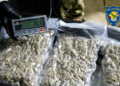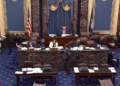
Legislators are back to testing the currents of political capital to reform federal cannabis as three new bills join SAFE Banking on the docket. now that the Drug Enforcement Agency has concluded its two-week long series of hearings on rescheduling.
The bills include creating a safe harbor for insurance companies, saving the hemp industry with a regulatory framework and outright descheduling cannabis.
The moves come in the weeks after the Drug Enforcement Agency’s rescheduling hearings concluded on July 15. Hearing participants have until August 17 to file any post hearing briefs. There is no clear deadline for action from the DEA, as there are currently multiple lawsuits pending that challenge the validity of the hearing and rescheduling as a whole.
For now, legislators are trying to take cannabis reform into their own hands.
Sen. Kevin Cramer, R-N.D., and Sen. Ruben Gallego, D-Ariz., filed the Clarifying Law Around Insurance of Marijuana Act on July 22, which would protect insurance companies that serve cannabis-related businesses (CRB)
The bill would prohibit federal agencies from punishing insurance companies that work with state-legal CRBs, while also allowing those companies to maintain their own discretion when deciding whether to terminate existing policies based on proximity to the cannabis industry.
“Much like marijuana businesses are barred from using bank accounts, they are also locked out of insurance markets,” said Cramer. “Businesses, as we know, obviously assume risk [because] that’s part of being in business. But the risk for cannabis companies that operate in states where it’s actually legal is especially high. The CLAIM Act makes sure insurers can offer their commercial products to regulated marijuana-related businesses without fear of federal prosecution.”

Interestingly, Cramer is from North Dakota, which only allows legal medical cannabis. Most often, sponsors and co-sponsors of bills such as CLAIM or SAFE Bank are led by legislators from states with legal adult-use.
“In states that have legalized marijuana, including Arizona, legitimate cannabis businesses should have the same access to insurance coverage as any other business,” said Gallego. “I’m proud to partner with Senator Cramer to introduce this commonsense, bipartisan fix.”
Legalized Hemp Gets Another Chance Ahead of November
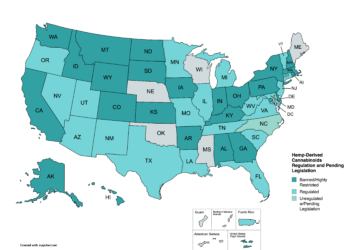
Andy Barr, R-Ky., announced on July 22 the introduction of the Lawful Hemp Protection Act, which would block what is essentially a total ban on hemp-derived cannabinoids that goes into effect on Nov. 12. Angie Craig, D-Minn. is a co-sponsor of the bill.
The new bill would create a regulatory frameworks for consumable hemp, which would include products with CBD as well as intoxicating cannabinoids. This framework would be distinct from the rules that govern industrial hemp.
Products that contain hemp-derived cannabinoids would have to be tested throughout the supply chain process, and packaging requirements would be established. They would also have to be age-gated to prevent purchase from those under 21.
The bill would allow products to contain up to 1% THC in terms of total dry weight. In contrast, the current limit under the 2018 Farm Act is 0.3% delta-9 THC, while the Nov. 12 change would reduce the limit to 0.4 mg of total THC, regardless of the dry weight. The bill’s language has not been released, so it remains unclear if the 1% limit applies to delta-9 THC, THCA or other variations of THC.
The bill calls on the Food and Drug Administration to set a per-serving limit for THC products within a year, or revert to a standard 5 mg for edibles and drinks, and 50 mg for inhalants, such as vapes and pre-rolls.
Hemp beverages would also be regulated under a three-tier system requiring separate supply chain operators. Basically, a single company could operate as a cultivator, processor or retailer, but not all three.
“Reps. Craig and Barr understand that this isn’t a partisan issue – it’s about protecting farmers who planted in good faith, small business owners who built legal companies, and consumers who deserve safe, tested, legal products instead of being pushed into an unregulated market,” said Hemp Industry & Farmers of America Executive Director Brian Swensen.
SAFE Banking remains in play
The SAFE Banking Act to improve banking and lending to cannabis-related businesses (CRB) was refiled days for the DEA’s hearings began. Similar to previous attempts to protect financial services for CRBs, this bill would protect financial institutions that serve CRBs and associated businesses. This would include prohibiting the federal government penalizing banks or discouraging them from interacting with state-legal cannabis or hemp businesses.
The latest iteration of SAFE Banking was actually filed days before the of the DEA’s July hearings. The Senate’s version, S 4942, submitted on June 24, followed by HR 9471 in the House on June 25. The two bills have identical language.
S 4942 is sponsored by Sen. Jeff Merkley, D-Ore. Cosponsors include Lisa Murkowski, R-Alaska, Steve Daines, R-Mont., and Elizabeth Warren, D-Mass.
HR 9471 is sponsored by Rep. David Joyce, R-Ohio. He is joined by James Himes, D-Conn., Warren Davidson, R-Ohio, Nydia Velazquez, D-N.Y., Brian Mast, R-Fla., Lou Correa, D-Calif., Guy Reschenthaler, R-Penn., and Dina Titus, D-Nev.
This bill was referred to the Subcommittee on Economic Opportunity on July 17. The bill was previously referred, on June 25, to the Committee on Financial Services, the Committee on the Judiciary, and the Committee on Veterans’ Affairs,
On a less bipartisan note, senators Chuck Schumer, D-N.Y., Cory Booker, D-N.J. and Ron Wyden, D-Ore., refiled the Cannabis Administration and Opportunity Act on July 16, with 14 additional Democratic senators signing on.
If passed, it would decriminalize cannabis by completely descheduling the plant and its byproducts. The bill would also establish a regulatory framework for legal cannabis, with additional protections for banking institutions, and market competition rules intended to serve smaller businesses. Oversight of cannabis would be moved from the Department of Justice to the Food and Drug Administration.