The Trump Administration is blessing state medical marijuana licensing programs as part of a final order published by acting Attorney General Todd Blanche.
Blanche announced the movement of marijuana from Schedule I of the Controlled Substances Act (CSA) to Schedule III on Thursday, April 23, after President Donald Trump complained the Department of Justice was “slow-walking” his December executive order to get rescheduling moving.
The rescheduling process originally started in 2024 under President Joe Biden, but it has been suspended since January 2025.
Blanche uses his authority under the United Nations Single Convention on Narcotic Drugs to make an immediate rescheduling order. But the DEA simultaneously terminated the Biden Administration hearings and scheduled a new administrative hearing for June 29.
The new rulemaking hearing “will provide a timely and legally compliant pathway to evaluate broader changes to marijuana’s status under federal law,” the DOJ’s press release said. “Together, these actions provide immediate and long-term clarity to researchers, patients, and providers alike while still maintaining strict federal controls against illicit drug trafficking.”
‘Cooperative federalism’ with legalized cannabis states
While rescheduling doesn’t officially legalize marijuana, Blanche announced a plan to recognize state-legal medical programs.
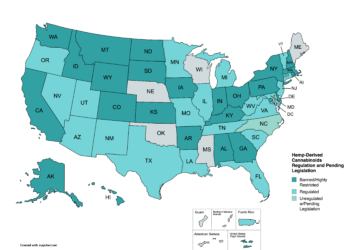
In the final order, he mentioned that 40 states have created legal, regulated medical marijuana programs over the last 30 years. Because Schedule III requires a lengthy legal process for the Federal Drug Administration to approve drugs, he’s using the Single Convention to allow state-legal products.

He said that under the Single Convention, he doesn’t need any recommendation from the Department of Health and Human Services. But he recognizes that HHS’s recommendation in 2023 to reschedule marijuana to Schedule III is the option that “best positions the United States to carry out its obligations” under the Single Convention.
“Namely, I am hereby ordering that FDA-approved drug products containing marijuana, as well marijuana in any form covered by a state medical marijuana license, be placed in schedule III of the CSA.”
He said state licensing regimes have developed infrastructure to prevent diversion, ensure product safety, maintain records and conduct facility inspections, which fulfill federal requirements.
“In light of that record, the Attorney General has determined that incorporating state licensing systems into the federal registration framework represents the most effective and efficient means of achieving the CSA’s objectives with respect to medical marijuana while promoting the medical benefits of marijuana and causing the least disruption for patients and existing state systems,” the order said.
“This approach reflects the Attorney General’s considered judgment that cooperative federalism best serves the statutory purposes of the CSA in the context of a well-regulated medical marijuana market,” it continued.
One of the driving forces toward rescheduling is to increase research. Under current law, any federal research must use marijuana grown from a DEA-approved lab, which will likely limit studies. This final order would create a pathway to allow state-licensed manufacturers, distributors and dispensers to get DEA registration. It also removes civil and criminal penalties for researchers who obtain state-licensed marijuana, as long as it has a DEA registration.
The Administration plans an expedited review process to approve federal registration. “The Administrator shall make every effort to process all applications submitted within 60 days of the publication of this regulation in the Federal Register within six months,” the order said.
280E tax restrictions lifted
This final order also immediately lifts the 280E federal tax restriction that prevents cannabis companies from deducting ordinary expenses. Not only that, but it recommends applying this change retroactively, which will benefit large MSOs that have challenged the tax rule, including Trulieve Cannabis Corp., TerrAscend Corp. and Ascend Wellness Holdings Inc.
“The Administrator encourages the Secretary of the Treasury to consider providing retrospective relief from Section 280E liability for taxable years in which a state licensee operated under a state medical marijuana license,” the order says.
Verano Holdings Chief Executive Officer George Archos applauded the “historic rescheduling” news in an emailed statement. “We’ve previously quantified rescheduling would save Verano an estimated $80 million in annual 280E expenses that we could invest back into our operations, putting us on a level playing field with any other legal business,” he said in the company’s fourth quarter 2025 earnings call.
The market responded with volatility. After a surge following initial news reports of rescheduling, stocks abruptly reversed course as investors engaged in profit-taking sell-offs, according to CRB Monitor Chief Research Officer James B. Francis. By Thursday afternoon, the big publicly traded cannabis-related business stock prices dropped 10% to 22%.
“While rescheduling to Schedule III removes punitive 280E tax restrictions and improves access to banking, it stops short of full federal legalization,” Francis explained. “While this sounds like a significant step, most CRBs operating in the United States hold substantially more recreational than medical licenses, meaning they will derive very little benefit from 280E relief.”
Cannabis opponents ready to fight back
Blanche and his team carefully described why he has the authority to make this immediate order under the international treaty. But prohibitionist groups aren’t buying those arguments.
One of the strongest lobbyist groups, Smart Approaches to Marijuana (SAM), condemned the order “in the strongest possible terms” and is preparing to sue.
“He [Trump] illegally made the decision to defer the authority on medical marijuana research licensing under Schedule III to state ‘medical’ marijuana programs,” SAM said in an emailed statement to supporters. “Not only does he not have the authority to do this — this is backdoor legalization of the state-run ‘medical’ marijuana programs that have devastated families across the country.“