The Michigan cannabis regulator has accused a lab of “peak shaving,” a way of fudging test results that’s a problem occurring throughout the industry nationwide, according to a compliance consultant.
The Michigan Cannabis Regulatory Agency (CRA) has filed two formal complaints against Prism Triangle in Walled Lake, Mich., this year. The latest was April 7, and the first was on Jan. 26.
In both, Prism Triangle is accused of peak shaving, which resulted in “inaccurate and unreliable test results,” for delta-9 THC and the banned pesticide bifenazate, which is used to control spider mites. The company was also accused of improperly testing for aspergillus.
Kim Anzarut, founder and CEO of Allay Consulting in Denver, said peak shaving is “a huge concern that has been around for a really long time.”
She explained that with peak shaving, labs adjust the bottom testing number to yield the results they want. For example, if a rate is 0/50, below zero would be non-detect. A lab could increase the numerator so non-detect is at 10.
“They can make it as narrow or as wide as they want to skew the lab results,” she said.
Lab allegedly didn’t follow approved procedures
Importantly, licensed labs must follow standard operating procedures (SOP)s that are approved by the CRA.

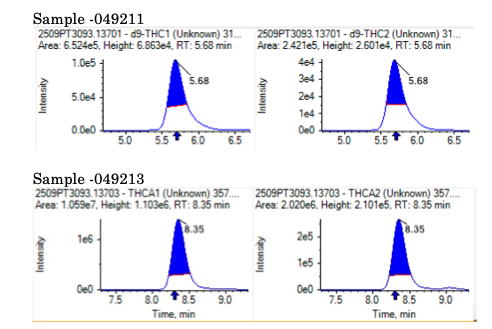
According to the January complaint, the CRA received information questioning the validity of compliance tests Prism performed in March 2025 related to chemical residues. Upon review, the CRA found that Prism allegedly didn’t follow their approved SOP for pesticide sample preparation. They said data reports revealed that Prism performed peak shaving.
“Respondent manually integrated the peak on the quality control sample to remove or ‘shave off’ part of the area under the peak,” CRA alleged, which “allowed the testing instrument to reflect proper calibration for bifenazate testing despite Respondent’s failure to properly calibrate the instrument.”
CRA staff interviewed the lab’s technician on Oct. 30. “Respondent’s lab technician, AG, confirmed that Respondent manually integrated the peak used to verify the calibration for bifenazate tests,” the complaint states.
In August 2025, following a question about microbial test results, the CRA determined Prism didn’t follow its approved SOP for aspergillus testing. Another lab technician admitted to using an unapproved plating method, the January complaint said.
Two months later, CRA received a new information questioning Prism’s testing of THC content in infused pre-rolls.
In this case, CRA asked Prism and another lab that had tested the same batch samples to retest their samples. Then they were directed to switch samples and test each other’s for potency.
“Following the audit, the CRA found noticeable discrepancies in THC content between the results reported by Respondent and the other lab,” CRA said in the April complaint.
During a visit to the facility in November, CRA staff determined Prism again used peak shaving which yielded “inaccurate and unreliable results” for delta-9 THC and THCA in samples. And again, Prism staff admitted in January to not following the CRA-approved SOP for potency testing, according to the complaint.
Prism was charged with eight violations in the January complaint and four violations in April. The complaints are notices of intent to impose fines and/or other restrictions including suspension, revocation, restriction and refusal to renew their license. They had 21 days for each complaint to request a hearing. As of May 5, no hearing dates had been requested, according to a CRA spokesman.
The spokesman declined to comment or provide more information on the investigation and would not say whether the allegedly fraudulent testing led to any recalls.
There was one recall in September because of a banned chemical. IVP Holding LLC, doing business as House Brands Distro, voluntarily recalled Top Smoke vapes produced on Feb. 25, 2025.
Attempts to call and email Prism Triangle representatives were unsuccessful. Nobody from House Brands Distro responded to emails attempting to confirm whether their recalled products were tested by Prism Triangle.
No real cannabis testing standards
Anzarut’s a member of Advancing Standards Transforming Markets (ASTM), an international group that creates testing standards for a variety of industries. She has been volunteering to write cannabis testing standards since 2017.
Anzarut explains that peak shaving happens at nearly every testing lab because there are no uniform standards. Cannabis regulatory agencies are usually part of licensing or tax departments, not health departments, so most regulators trust the labs to set their own SOPs.
“I do not know of a state that has an established base level that every testing lab is required to test to at this time when it comes to contamination,” she said, although some states may have baseline levels for potency.
She said non-detect baselines should be established at the federal level. And she believes “100 percent” that the Trump Administration’s move of cannabis to a Schedule III drug will help federal agencies, such as the FDA, to get involved.
Until then, manufacturers pick the labs that deliver the test results they want, said Anzarut. “Labs testing for actual public safety are going out of business.”