More than three years after the New York Office of Cannabis Management began approving social equity cannabis retail licenses, the businesses that have managed to open struggle to survive.
The Conditional Adult Use Retail Dispensary (CAURD) licensing program was meant to help those who had been targeted in the war on drugs own a small business in the new adult-use market. But from the outset, it was mired in legal challenges that delayed licensing approval and a state-run/private partnership loan program that straddled borrowers with growing debt.
A small coalition of these business owners have joined other legal cannabis advocacy groups to get state legislators’ attention and ask for fixes they feel are necessary for their survival.
CAURD Inc. led a “We Did Our Part” lobby day in Albany on April 28. The group’s chairman is Fernando Pena, owner of Late Bloomers dispensary, the first business to get a CAURD license. The group is advised by Dasheeda Dawson, the former director of Cannabis NYC, a counseling program within the state’s Department of Small Business Services (SBS).
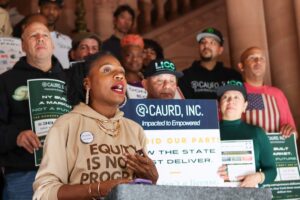
“Equity is survival. It’s not just the licensing,” Dawson said during a debriefing of the event. “It’s about whether the business survives long enough to deliver on [the program’s] promise.”
Pena said when he and his wife Suzanne Furboter opened their dispensary in the Richwood District two years ago, the business grew nicely with little social media marketing. Since then, “A lot of my peers, including myself, are down 40%,” as competition increased and consumer preferences changed, he said.
As a result, he’s struggling to pay rent, taxes and a loan from the state’s Cannabis Social Equity Investment Fund.

“Everyone is getting paid except for us. We are living paycheck to paycheck,” he said.
Through the state’s lending program, Pena leased his storefront from the Dormitory Authority of the State of New York (DASNY) and received a $1.5 million loan for construction costs. The 10-year loan has a 13% interest rate.
He said his rent is nearly $18,000 a month, including fees. And he owes $300,000 in taxes. He’s paid back $300,000 of the loan, but stopped making payments in July. Fortunately, lender Chicago Atlantic hasn’t enforced loan payments so far, he said.
“You can walk away from the loan; you can’t walk away from taxes,” he said. “I’m scared we’ll have our business taken away from us and be left with this tax debt.”
He formed CAURD Inc. with several other business owners to get help at the state level. “We did our part, now do yours,” Pena said of state officials.
Cannabis businesses lobby Albany
On April 28, members of 22 cannabis organizations and 42 business operators boarded a bus and visited more than a dozen legislative offices to outline the problems in the industry, according to Dawson. While they didn’t meet with anyone in the executive chamber, they did field calls.
Dawson said the main problems they’re seeing in the New York cannabis market include unsustainable debt, predatory ownership and limited reinvestment.
Their priorities are to fix the social equity financing “traps” and use some of the $25 million currently sitting in the Community Grants Reinvestment Fund to help stabilize retail operators.
At the executive level, they specifically call for DASNY loan adjustments and restructuring.
They’re asking the state legislature to advance anti-monopolization protections and guardrails to prevent predatory consolidation. They’d also like funding to invest in social equity businesses and sustainable retail policies.
The industry does have support from some legislators, namely Sen. Liz Krueger. But the lawmakers are asking for guidance on what legislation to support. Dawson said there are more than 200 bills this session with the word “cannabis” in them.
Pena said the lawmakers understand the struggles, but, “They don’t know how to fix it. They need that bill.”
The problem is they have little time to enact change. The group hopes they’ll at least get a hearing “to create a public record of evidence” before the legislative session ends June 4. They also plan follow-up meetings with assemblymembers and senators.
Additionally, CAURD Inc. wants the Office of Cannabis Management to enforce predatory ownership violations and provide other retail viability regulations, such as removing cash-on-delivery (COD) requirements.
Dawson joked that the OCM is like a reality show. “We’re on the third season with a third director,” she said. Gov. Kathy Hochul named John Kagia, acting executive director in February. He’s been with OCM since 2014.
NYC Loan Fund opens second phase
The state’s Cannabis Social Equity Investment Fund was a failed experiment where DASNY subleased storefronts to licensees and lent them money to build out the retail space. Owners complained they had no control over build-out costs. In the end, only 24 properties were leased before the program was shut down in 2024 amid controversy while borrowers like Pena are straddled with debt.
At the same time, New York City launched its own cannabis business lending program. Phase 1 of the NYC Loan Fund was specifically meant to help CAURD licensees. After two years, it distributed only $1 million to 13 borrowers in loans of up to $100,000.
Operated by the SBS and Economic Development Corporation, the program recently entered phase 2, which is open to all licensed cannabis businesses in New York City, doubling the pool of potential applicants to 540 licensees, according to an April 20 press release. The application deadline is May 25.
Newly opened or pre-operational businesses can qualify for loans of up to $100,000. Businesses operating for at least a year can apply for up to $500,000. The interest rate is 9.5%. The term is three years, with the first six months requiring only interest payments.
The city expects to lend more than $6 million in this round. The fund is managed by cannabis-industry venture capital firm Tuatara Capital.
“Access to affordable capital is one of the biggest hurdles to success for small businesses across sectors, and this is especially true for New York City’s legal cannabis entrepreneurs – many who are justice-involved individuals,” said SBS Commissioner Kenny Minaya in the press release.
“Today’s expansion of the Cannabis NYC Loan Fund will create a more equitable industry and increase access to affordable capital for early-stage cannabis businesses,” added EDC Interim President and CEO Jeanny Pak.