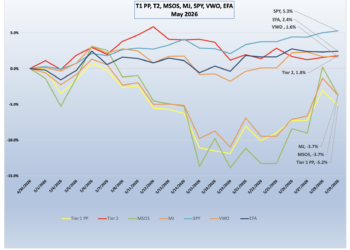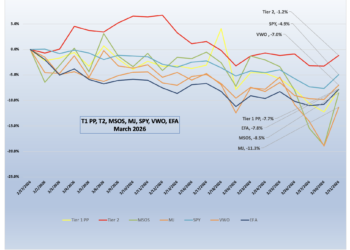
Cannabis-themed equities experienced a highly volatile, but news-driven month in April 2026, largely shaped by shifting U.S. federal policy expectations. Early in the month and into mid-April, sentiment turned sharply positive as investors anticipated—and then reacted to—moves to reclassify cannabis from a Schedule I to a less restrictive Schedule III drug. This perceived “game-changer” drove broad-based rallies across both individual names and ETPs, with some funds and stocks posting double-digit short-term gains amid optimism about improved research access, reduced tax burdens, and increased institutional capital flows. However, these gains proved short-lived, as markets quickly reassessed the limited scope of the policy change, which primarily applied to medical and FDA-approved products rather than full federal legalization.
But wait! A late-April rebound in cannabis equities—particularly among U.S. MSOs—was largely a technical and sentiment-driven snapback following the overdone, post-rescheduling selloff. After the initial enthusiasm around cannabis being moved toward Schedule III gave way to a sharp “sell the news” reversal, many MSO names were deeply oversold (even for MSO stocks), prompting a surge in short covering and opportunistic buying. At the same time, renewed investor focus on the tangible financial benefits of rescheduling—especially potential relief from IRS Section 280E—helped re-anchor the fundamental narrative, even without new policy developments. This combination of positioning unwind, bargain hunting, and modest ETF inflows created a broad-based rally into month-end, with gains amplified by thin liquidity and high price multiples across the sector.
CRB Monitor News Featured Article: Will Rescheduling Increase Cannabis Research?
The proposed federal rescheduling of cannabis has renewed the debate over its potential to expand scientific and medical research. Moving cannabis to a less restrictive classification could reduce administrative barriers for researchers, improve access to funding, and enable more clinical trials. However, experts caution that meaningful research expansion will still depend on regulatory clarity, institutional willingness, and infrastructure development beyond the scheduling change itself.
Click here for the full article on our CRB Monitor News website.
The two largest US plant-touching cannabis-themed ETFs, the Amplify Alternative Harvest ETF (NYSE Arca: MJ) (+19.9%) and the actively-managed MSO-heavy Advisorshares Pure US Cannabis ETF (NYSE: MSOS) (+43.9%) enjoyed the abovementioned rebound but still have a long way to go to claw back several years of negative performance.
Cannabis-Linked Equity Performance
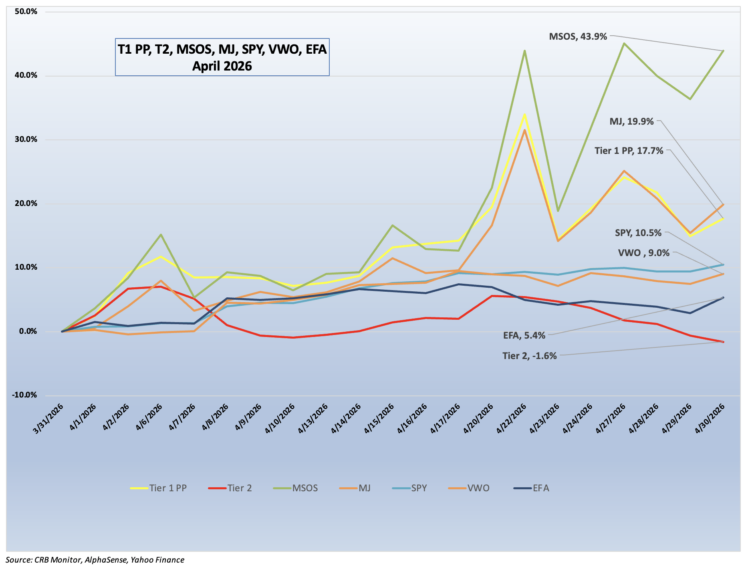
The CRB Monitor equally-weighted basket of top Pure Play Tier 1 CRBs closed out April with a return of +17.7%. This portfolio is an equally-weighted basket of the largest pure play Ther 1 CRBs (representing both US plant-touching and non-US plant-touching MJ companies). The CRB Monitor equally-weighted basket of Tier 2 CRBs underperformed the Tier 1 CRB basket, posting a -1.6% return for April 2026. In August 2025 CRB Monitor published an update to our article on correlations of Pure Play Tier 1 and Tier 2 CRBs, which also analyzed the correlations of MSOs and Canadian operators. What we have observed historically is that these two groups tend to display high correlation (>0.50) in the long term, while their respective performance has a tendency to diverge in the short term. This can be due to (among other factors) the lag from the impact of market forces (in this case marijuana rescheduling) that affect their sources of revenue that are derived from the Tier 1 group. If this theory holds, investors would be expected to load up on Tier 2 CRBs in the short term and we would witness this gap narrow over time.

U.S. equities’ strong double digit gain in April 2026 was driven by a powerful combination of policy optimism, earnings resilience, and momentum in mega-cap growth stocks. A key catalyst was increasing confidence that the Federal Reserve would begin cutting interest rates later in 2026, as inflation showed tentative signs of easing, which boosted valuations and risk appetite. At the same time, better-than-expected corporate earnings—particularly from large-cap technology and AI-exposed companies—reinforced the durability of profit growth, attracting incremental capital into equities. The rally was further amplified by short covering and systematic inflows, as investors who had been defensively positioned earlier in the year were forced to re-enter the market, resulting in broad-based gains across sectors and a sharp upward move in index-level performance.. The S&P 500 (represented by the SPDR S&P 500 ETF Trust (NYSE Arca: SPY) posted a return of +10.5% for the month of April.
Largest Tier 1 Pure Play & Tier 2 CRBs by Market Cap – April 2026 Returns
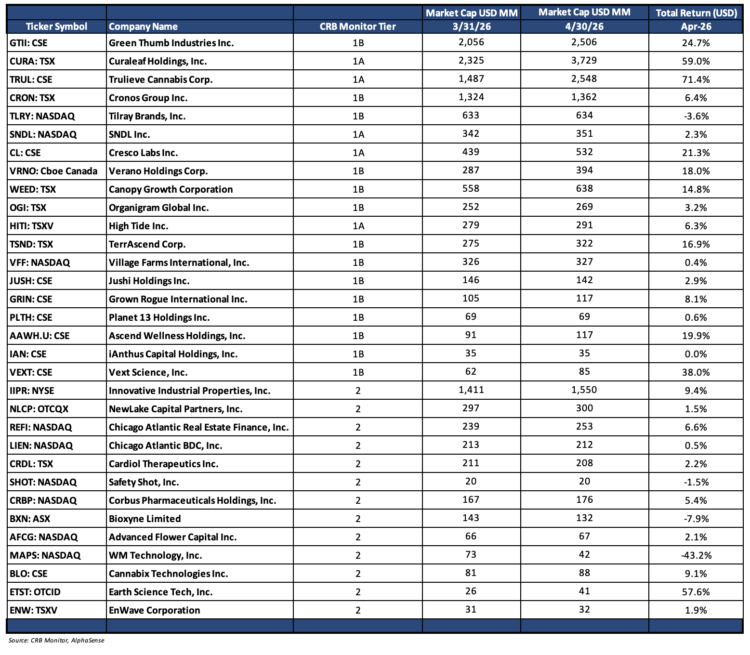
An equally-weighted basket of the largest Tier 1 pure-play cannabis equities (a combination of MSO and CAD companies) rallied in April, largely related to rescheduling news. Tier 1 CRBs finished the month ahead of the Tier 2 basket (+17.7% vs. -1.8%).
CRB Monitor Tier 1
The a wide range of returns across the Tier 1 CRB universe in April 2026 was largely a reaction to US rescheduling news. In the MSO basket, Trulieve Cannabis Corp. (CSE: TRUL) (+71.4%), Tier 1B Cresco Labs Inc. (CSE: CL) (+21.3%), Tier 1Bs TerrAscend Corp. (TSX: TSND) (+16.9%) and Curaleaf Holdings, Inc. (CSE: CURA) (+59.0%) all benefitted from the news cycle. Similarly, Tier 1B Verano Holdings Corp. (CSE: VRNO) (+18.0%), and Green Thumb Industries Inc. (CSE: GTII) (24.7%) responded well to April rescheduling revelations.
Companies in the Canadian CRB basket, which tend face a lighter impact from US cannabis reform-related news (either positive or negative) than MSOs, also had a nice April. Tier 1A SNDL, Inc. (Nasdaq: SNDL) (+2.3%) and Tier 1B CRB Canopy Growth Corporation (TSX: WEED) (+14.8%), Tier 1B craft beverage giant Tilray Brands, Inc. (Nasdaq: TLRY) (-3.6%), Tier 1B High Tide Inc. (TSXV: HITI) (+6.3%) and Tier 1B Cronos Group Inc. (TSX: CRON) (+6.4%) were all affected negatively by the lapse in global equities.
As we have stated regarding these two groups (MSOs and CADs), short-term performance has deviated between the CAD and the MSO baskets, but they tend to mean-revert over time and historical correlations are high. It is also worth mentioning that as an industry cannabis has fallen to the point where no company’s stock can even be regarded as a small capitalization stock; over the last few years they have all shrunk (some by more than 90%) to the point where they are considered micro-caps and consequently non-investable by most institutions from a policy perspective. For more detail on the MSO/CAD relationship, please see our August 2025 Chart of the Month on our CRB Monitor News website.
CRB Monitor Tier 2
An equally-weighted basket of the largest CRB Monitor Tier 2 companies outperformed the Tier 1 basket in April 2026 significantly, posting a return of -1.2%. Historically the performance of these two portfolios (given their close business ties) has displayed high correlation (please see our recently-published August 2025 “Chart of the Month”), and we expect the returns of Tier 1 and Tier 2 CRBs to mean-revert over time. When the two baskets deviate from one another in the short term, the deviation could be a signal for investors to rebalance into (out of) the Tier 1 basket and out of (into) Tier 2’s given their direct revenue relationship. This is due to the fact that Tier 2 CRBs are direct suppliers of goods and services to (and derive their revenues from) Tier 1 CRBs. However, the precise moment when these two baskets mean revert is not easy to predict and the costs required to systematically rebalance these illiquid portfolios could eat up any expected material gains from even the best rebalance strategy. In other words, gaming these two baskets can lead to losses, so proceed with caution!
The performance of the largest CRB in the Tier 2 basket, well-known REIT Innovative Industrial Properties, Inc. (NYSE: IIPR) (CRBM Sector: Real Estate) (-4.1%) was off, following three positive months. On February 23rd IIPR reported its 4th quarter 2025 results which featured the following highlights:
- Total revenues of $266.0 million and net income attributable to common stockholders of $114.4 million, or $3.93 per diluted share (all per share amounts in this press release are reported on a diluted basis unless otherwise noted).
- Adjusted funds from operations (“AFFO”) of $205.4 million, or $7.24 per diluted share.
- Declared dividends to common stockholders totaling $7.60 per share, increasing IIP’s common stock dividends declared each year since its inception in 2016. Since its inception, IIP has paid over $1.1 billion in common stock dividends to its stockholders.
Tier 2 REIT Advanced Flower Capital, Inc. (Nasdaq: AFCG) (CRBM Sector: Real Estate) (+25.2%) had a strong April, outperforming nearly all CRBs. On April 4th AFCG reported its 4th Quarter 2025 financial results (featuring a net loss of $12.5) and the statement from CEO Daniel Neville:
“In 2025, we focused on disciplined portfolio management and the successful completion of our BDC conversion. As a BDC with a broader investment universe, we remain focused on unlocking value from underperforming loans and redeploying that capital into high-quality, cash-flowing businesses in the lower middle market…In short, we remain committed to resolving legacy positions and leveraging our robust pipeline to drive long-term value for our shareholders.”
Tier 2 technology company, WM Technology, Inc. (Nasdaq: MAPS), operates Weedmaps, the leading online listings marketplace for cannabis consumers and businesses, and WM Business, the most comprehensive SaaS subscription offering sold to cannabis retailers and brands. WM Technology’s stock was negative for the third month in a row, with a -2.8% return for April. On April 12th, MAPS reported its 4th Quarter 2025 earnings, with the following chilling headlines:
- Revenue of $174.7 million decreased from $184.5 million in the prior year. The decrease from the prior year was driven by continued headwinds across core markets, where ongoing pricing pressure and price deflation continued to compress client operating margins and constrain marketing budgets.
- Average monthly paying clients(1) of 5,190 was up from 5,077 in the prior year. The increase from the prior year period was largely due to new client acquisitions across certain developing markets, partially offset by a churn in more established markets.
- Average monthly revenues per paying client(2) of $2,805 decreased from $3,029 in the prior year. The decrease from the prior year period was due to spend declines in established markets driven by continued industry challenges, such as price deflation and ongoing consolidation. In addition, new clients acquired across certain markets had lower levels of average spend.
- Net income decreased to $3.3 million from $12.2 million in the prior year.
- Adjusted EBITDA(3) decreased to $39.8 million from $42.9 million in the prior year.
CRB Monitor Securities Database Updates
CRB Monitor’s research team monitors the information cycle daily and maintains securities’ profiles to reflect the current state of the cannabis ecosystem. Here is a summary of the updates for April 2026:
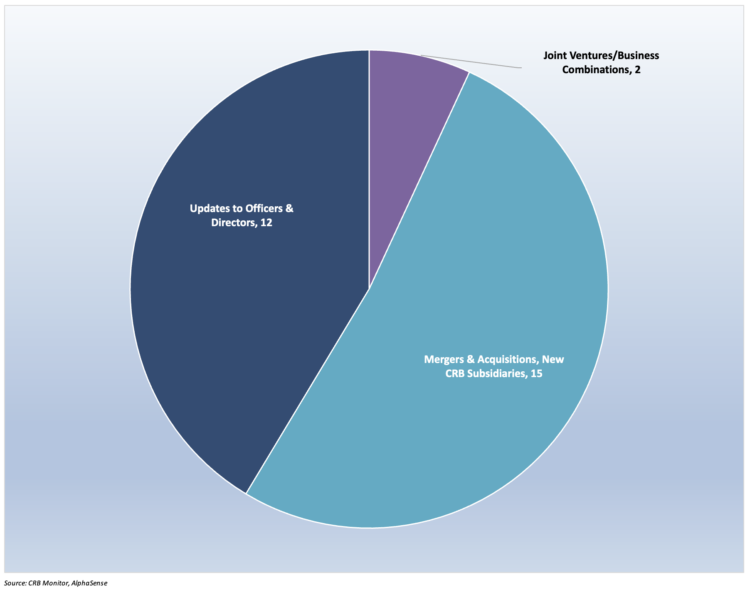
Cannabis Business Transaction News – April 2026
As we have for more than a decade, the CRB Monitor research team covers the cannabis business news cycle daily. Our goal is to remain up to date on all the relevant information vital to the ongoing breadth and accuracy of our data in the CRB Monitor securities database. And while the cannabis industry has faced major regulatory obstacles over those years, there has never been a shortage of news as licensed CRBs’ operations evolve to survive in a complicated business and regulatory environment.
On that note, here are some of the cannabis company news stories from April 2026:
Cresco Labs Awarded Texas Medical Cannabis License
Tier 1A MSO Cresco Labs announced that it has been conditionally awarded a vertically integrated license under Texas’ Compassionate Use Program, allowing the company to cultivate, process, and dispense medical cannabis in the state. The license represents a significant expansion opportunity into one of the country’s largest potential medical cannabis markets and strengthens Cresco’s footprint in limited-license states. CEO Charlie Bachtell emphasized the company’s regulatory expertise and ability to enter markets efficiently while supporting patient access to consistent, high-quality medical cannabis products. Industry observers on Reddit noted that the Texas program’s vertically integrated structure could create major long-term opportunities for established multistate operators. Cresco currently holds 77 active cannabis licenses and has operations in 15 states.
AYR Wellness Announces Closing of Exit Facility and Related Transactions
Tier 1B MSO AYR Wellness announced the initial closing of a major restructuring transaction involving the transfer of its Virginia operations into a new entity backed by senior secured noteholders and the launch of a new $275 million senior secured exit facility. The transaction is intended to reduce leverage, improve cash flow, and stabilize the company’s financial position as it continues broader restructuring efforts under Canadian creditor protection proceedings. Additional state assets are expected to transfer into the new structure pending regulatory approvals, while existing debt obligations are being converted into new financing and equity arrangements. The deal marks a critical step in AYR’s effort to streamline operations and preserve long-term viability amid broader financial pressures facing the cannabis industry. Ayr Wellness holds 44 active cannabis licenses and operates in 10 states.
High Tide, Inc. Celebrates 4/20 with New Canna Cabana in Caledonia, Ontario
Tier 1A Canadian CRB High Tide Inc. celebrated the April 20 cannabis holiday by opening a new Canna Cabana retail location in Caledonia, Ontario, expanding the company’s nationwide store count to 221 locations. The new store is strategically positioned in a growing commercial corridor with limited nearby cannabis competition and is expected to serve consumers throughout Caledonia and the surrounding Haldimand County region. CEO Raj Grover highlighted the symbolic significance of the 4/20 opening as the company approaches eight years since launching its first Canna Cabana store and emphasized High Tide’s continued focus on value-driven retail expansion. Online community reactions praised the store’s location and market positioning, though some customers noted limited grand-opening promotions. High Tide holds 227 active licenses and operates in six Canadian provinces.
Trulieve to Open Medical Cannabis Dispensary in Boca Raton, Florida
Tier 1A MSO Trulieve Cannabis Corp. announced plans to open a new medical cannabis dispensary in Boca Raton, Florida, further expanding the company’s already dominant retail footprint in the state. The location will serve patients in Palm Beach County and feature grand opening promotions, discounts, and educational outreach as part of Trulieve’s broader patient-focused strategy. CEO Kim Rivers said the expansion reflects the company’s commitment to improving access to high-quality cannabis products and delivering strong customer experiences throughout Florida. The new store continues Trulieve’s steady expansion across key Florida markets as competition intensifies among major multistate operators. Trulieve holds 114 active cannabis licenses and operates in 16 states and 3 Canadian provinces.
Verano expands in Florida with opening of MÜV Miramar Beach
Tier 1B MSO Verano Holdings announced the opening of MÜV Miramar Beach, its 85th Florida dispensary and 162nd retail location nationwide, strengthening the company’s presence along Florida’s Emerald Coast. The store is strategically located on a high-traffic section of Highway 98 near popular beach destinations and represents Verano’s first dispensary in Walton County. The expansion complements existing Panhandle operations and reinforces the company’s focus on growing in high-demand tourism and residential markets across Florida. Verano stated that the opening supports its broader strategy of scaling operations in limited-license states while continuing to build brand recognition nationwide. Verano holds 74 active cannabis licenses and operates in 16 states.
Vireo to acquire Fluent
Tier 1A MSO Vireo Growth Inc. has entered into a definitive agreement to acquire FLUENT Corp. in an all-stock transaction designed to significantly expand Vireo’s footprint in Florida and other core cannabis markets. The combined company is expected to operate approximately 74 Florida retail stores alongside expanded cultivation and production capacity, positioning Vireo more competitively in one of the largest medical cannabis markets in the United States. The transaction also includes debt restructuring measures aimed at improving FLUENT’s balance sheet before closing, which is expected later in 2026 pending shareholder and regulatory approvals. Executives from both companies described the acquisition as a strategic move to achieve greater scale and operational efficiency in increasingly competitive limited-license markets. Following this acquisition, assuming it is successful, Vireo’s footprint will expand to 17 states and it’s active US license count will be 68.
Select CRB Business Transaction Highlights
| Company Name | Ticker Symbol | CRBM
Tier |
Event |
| Cresco Labs Inc. | CSE: CL | Tier 1A | Cresco Labs Awarded Texas Medical Cannabis License |
| Ayr Wellness Inc. | CSE: AYR.A | Tier 1B | AYR Wellness Announces Closing of Exit Facility and Related Transactions |
| High Tide Inc. | TSXV: HITI | Tier 1B | Celebrates 4/20 with New Canna Cabana in Caledonia, Ontario (HIGH TIDE INC) |
| Trulieve Cannabis Corp. | CSE: TRUL | Tier 1A | Trulieve to Open Medical Cannabis Dispensary in Boca Raton, Florida |
| Verano Holdings Corp. | CSE: VRNO | Tier 1B | Verano expands in Florida with opening of MÜV Miramar Beach |
| Vireo Growth Inc. | CSE: VREO | Tier 1A | Vireo to acquire Fluent |
Officers/Directors Highlights
| Company Name | Ticker Symbol | CRBM Tier | Event |
| SNDL Inc. | NASDAQ: SNDL | Tier 1A | SNDL announces leadership transition for cannabis segment |
| TerrAscend Corp. | CSE: TER | Tier 1B | New CFO announced for TerrAscend |
| Cybin Inc. | NYSE:CYBN | Tier 1A | Helus Pharma Appoints Dr. Ken Kramer as SVP, Medical Affairs |
| Avicanna Inc. | TSX: AVCN | Tier 1B | Avicanna announces changes to its board of directors |
Select Updates to CRB Monitor
| Name | Ticker Symbol | CRBM Action | CRBM Tier/Sector |
| Cambria Cannabis ETF | CBOE: TOKE | Deleted | Tier 1B/ ETF – Cannabis-Themed |
| Greenbank Ventures Inc. | TSXV: GBNK.H | Moved to Watchlist | Tier 1A/ Licensed CRB |
| Digital Ally, Inc. | NASDAQ: DGLY | Moved to Watchlist | Tier 3/ IT Services & Software |
| Applied DNA Sciences, Inc. | NASDAQ: APDN | Moved to Watchlist | Tier 3/ Professional Services |
Cannabis News: Regulatory News Updates
We continue to closely follow the cannabis regulatory news cycle, which features developments from both state and federal levels of government as well as around the world. And as we have noted over the years, cannabis-related investment performance is primarily sentiment-driven and highly sensitive to news (rather than value or growth-based), particularly when the news comes from Washington. With that said, here are some of the April 2026 highlights:
VA Licensed Marketplace Awaits Governor’s Signature
Virginia’s cannabis market remains in a holding pattern as legislation to formalize a regulated retail framework awaits the governor’s approval. The bill is seen as a critical step toward transitioning from a limited medical system to a broader commercial marketplace, but political uncertainty continues to delay implementation timelines. Operators and investors are watching closely, as the governor’s decision will determine whether Virginia can emerge as a near-term growth market in the Mid-Atlantic region.
Delinquent Licensing Fees Lead to New Fines in CO
Colorado regulators have introduced stricter penalties for cannabis operators who fail to pay licensing fees on time, signaling a push toward greater compliance enforcement in a mature market. The new fines are intended to improve accountability and ensure stable regulatory funding, but they also add financial pressure to businesses already facing margin compression. This move reflects a broader trend of tightening oversight as state markets evolve and competition intensifies.
Medicare Hemp Program Moves Forward Despite Litigation
A federal initiative exploring hemp-based products within a Medicare-related framework is progressing despite ongoing legal challenges. Proponents argue the program could expand access to alternative therapies and integrate hemp-derived treatments into mainstream healthcare reimbursement systems. Critics, however, continue to question regulatory authority and safety standards, leaving the program’s long-term viability dependent on court outcomes.
Trump’s DOJ Issues New Rescheduling Order
A new directive from the Department of Justice under former President Trump has injected fresh momentum into the cannabis rescheduling process, reinforcing federal intent to revisit the drug’s classification. The order outlines a more structured approach to evaluating cannabis under existing legal frameworks, which markets interpret as a step toward regulatory normalization. Even so, uncertainty remains around timing, scope, and whether the changes will extend beyond medical use.
Rhode Island Licensing Trapped in Litigation Limbo
Cannabis licensing efforts in Rhode Island have stalled as ongoing litigation continues to delay the rollout of new business permits. Legal disputes over the licensing process have created uncertainty for applicants and slowed market expansion, frustrating both regulators and industry participants. Until the courts resolve these challenges, the state’s cannabis sector is likely to remain constrained despite underlying demand.
Massachusetts finally legalizes cannabis lounges, raises license cap
Massachusetts has enacted sweeping cannabis reforms, including finally authorizing social consumption lounges and increasing the number of retail licenses a single operator can hold from three to six. The law introduces three types of lounge licenses, allows cannabis delivery into municipalities that prohibit retail stores, and removes vertical integration requirements for medical operators, opening the market to more specialized businesses. It also doubles the individual purchase limit to two ounces and restructures the state’s Cannabis Control Commission to improve oversight after prior regulatory challenges. Overall, the reforms aim to modernize the market, support economic growth, and address longstanding industry bottlenecks.
Alabama medical cannabis market to finally launch
Alabama’s long-delayed medical cannabis program is set to launch in May 2026 with the opening of its first dispensary in Montgomery, marking a major milestone five years after legalization. Initially, nine dispensaries operated by three companies are expected to be running by summer, with up to 12 locations anticipated by year-end, alongside a growing network of approved physicians and registered patients. However, the rollout comes amid controversy, including a critical state audit highlighting governance and compliance issues within the regulatory commission. Despite these concerns, the launch represents a significant step toward providing legal medical cannabis access to patients in the state.
Wisconsin Democrats file bill to legalize adult-use and medical cannabis, regulate intoxicating hemp
Democratic lawmakers in Wisconsin have introduced legislation to legalize both recreational and medical cannabis while establishing a comprehensive regulatory framework for production, distribution, and sales. The bill also seeks to close gaps in the current “hemp loophole” by imposing stricter rules on intoxicating hemp-derived products, including age restrictions and dosage limits, and shifting higher-potency products into the regulated cannabis system. In addition to creating licensing structures and oversight mechanisms, the proposal reflects growing public support and broader national momentum for legalization, though it faces uncertain prospects in a divided legislature.
Wondering what a Tier 1, Tier 2 or Tier 3 CRB is?
See our seminal ACAMS Today white paper, Defining “Marijuana-Related Business,” and its update, Defining “Cannabis-Related Business”.
Wondering what a Tier 1, Tier 2 or Tier 3 DARB is?
See our seminal ACAMS Today white paper Defining ‘Digital Asset-related Business’ and Digital-Asset Related Businesses – What Financial Institutions Need to Know