Massachusetts cannabis regulators are considering a freeze on new cultivation licenses, just as their total possible canopy-to-resident ratio approaches levels seen in Michigan where prices have crashed over the last couple of years.
“Implementing a moratorium would deliver existing businesses a more predictable market and avert further price erosion from excess production,” said Cannabis Control Commissioner Kimberly Roy during the CCC’s Feb. 12 meeting. “The goal of a temporary freeze would be to stabilize this sector of the market, shift competition towards product quality and compliance over raw volume, and safeguard consumer access, public health and safety as we work to refine demand, forecasts and policy.”
Massachusetts launched its adult-use market in January 2020, after voters legalized it in 2018. By now, Massachusetts is home to nearly 3 million square feet of active canopy, with an additional 700,000 square feet of canopy currently pending.
These crops are grown by 134 active cultivator licenses, according to the CRB Monitor licensing database, of which 125 are in operation according to the CCC. In addition, 47 more licenses are currently in the pre-approval/pending phase.
Massachusetts has roughly 4.6 million residents over the age of 21, which means there are just over 1.2 square feet of cannabis canopy per resident old enough to use. Comparatively, that ratio is similar to Illinois and is approaching levels in Michigan where prices continue to drop.
Massachusetts has also seen a decline in tourist demand for cannabis now that every one of its border states, with the exception of New Hampshire, allows adult-use sales.
Flower prices crash 70%
Roy said “severe price compression persists as one of our most urgent challenges” as wholesale flower prices have crashed 60% to 70% since the market launched.

Flower prices were at $14.68 in January 2020. After a sharp drop in 2022, prices in Massachusetts appear to be leveling. The average price of a gram was $4.05 in January 2026, compared to $4.42 in January 2025, according to the state’s cannabis sales data.
“Unchecked canopy expansion has created structural oversupply and without swift intervention we continue to risk widespread economic harm to licensees,” said Roy.
Earlier this year, the commission began a policy where cultivators can drop down to a lower tier upon license renewal if they failed to fully use their allocated canopy limit.
The commissioners ultimately voted to schedule a public hearing about the proposed freeze within 30 days, which ends on March 14.
Quality vs. quantity
One of the state’s testing labs noted that slowing down the growth of supply would likely compel operators to focus on quality over quantity.
“Moments like this mark a turning point,” ProVerde Laboratories said in a social media statement. “When expansion slows, competition moves away from volume and toward fundamentals: product quality, operational discipline, and regulatory compliance.”
The move would also likely benefit existing operators who will not have to worry about increased competition.
“There is a perception in the commonwealth that we, the cannabis industry, are operating in a ‘free market.’ That’s simply not true. Limiting any licensure is not ‘free.’ It’s imperative that we either throttle the supply chain or free up retail,” said Meg Sanders, CEO and co-founder of Canna Provisions in an emailed statement.
Sanders said many successful industries in Massachusetts are limited in some way by the state. “The cannabis industry in Massachusetts is not operating at its full potential in its current form. So I support exploring the limitation or freezing of licenses,” she said.
Other mature cannabis markets limit licensing
Massachusetts would not be the first state to halt cannabis licensing.
Nationwide, the number of active licenses continues to slowly drop, while the number of pending or pre-approved licenses continue to stay about the same from quarter-to-quarter. As newer markets like New York continue to expand, more mature markets such as California and Oklahoma are seeing market corrections.
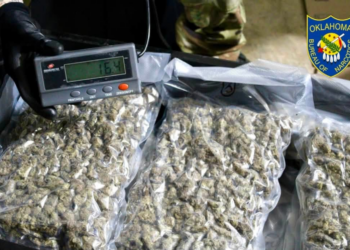
Oklahoma placed a two-year moratorium on new grower, processor and dispensary licenses in Aug. 26, 2022, which was subsequently extended to Aug. 1, 2026.
Michigan lawmakers have repeatedly considered enacting a moratorium on new licenses, but so far nothing has officially been put into place.
Montana’s legislature passed a two-year moratorium on new licenses that took effect on July 1, 2025. At the time the moratorium was first considered in early 2025, there were 320 cultivation, 423 retail and 165 processing licenses. Those numbers shifted to 345 cultivation, 579 retail and 200 processor licenses before the moratorium actually started, according to the CRB Monitor database.
Vermont similarly stopped issuing new cultivation licenses as of February 2025. The Green Mountain State had 360 active cultivation licenses as of Feb. 25, 2026.
Oregon instituted a de facto moratorium in early 2024 when Gov. Tina Kotek signed new license cap standards into law on March 20 of that year.
At the time, there were 1,374 cultivation, 806 retail, 299 processing and 259 wholesale licenses. Those numbers have since shifted to 1,359 cultivation, 768 retail, 277 processor and 241 wholesale licenses according to the CRB Monitor database.
With a small drop in licensed operators, the state may soon begin to review new applications for wholesalers and processors, but population growth remains decades away from when new retail and cultivator licenses are to be considered.