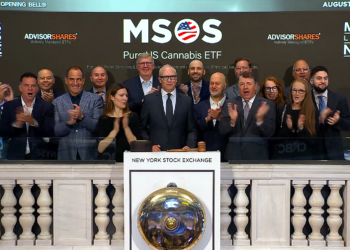
When the U.S. Department of Justice (D.O.J.) and Drug Enforcement Administration (D.E.A.) moved FDA-approved cannabis products and state-licensed medical marijuana products to Schedule III in April 2026 Cannabis equities soared. That said, adult-use cannabis remains a Schedule I substance under federal law, and a broader proposal to reschedule all marijuana to Schedule III is still undergoing administrative review, with DEA hearings scheduled to begin on June 29, 2026. And there are considerable hurdles before any benefits from rescheduling are fully realized.
Also in the spring of 2026, lawmakers and regulators have focused on intoxicating hemp-derived cannabinoids such as delta-8 THC and hemp-derived delta-9 THC. Federal proposals under consideration would tighten the definition of hemp and potentially restrict or ban many intoxicating hemp products, while a growing number of states have already enacted their own regulations or prohibitions. The regulatory outlook for intoxicating hemp remains uncertain, but momentum has shifted toward stricter oversight as policymakers seek to close perceived loopholes created by the 2018 Farm Bill.
As we juxtapose these two regulatory revelations (one decriminalization, one criminalization) of essentially the same substance, namely THC – the markets have gone back to their fickle, volatile norms.
Cannabis-related equities delivered a mixed but overall negative performance in May 2026, putting a slight damper on the sector’s recovery from the supercharged returns in April. The unfortunate reality for cannabis investors is that it will take nothing short of a miracle to fully erase the depressed valuations that characterized much of the past 5-6 years, but we digress. On the lighter side, investor sentiment was supported by continued optimism surrounding U.S. federal cannabis reform, particularly following the Trump administration’s move to reschedule certain cannabis products from Schedule I to Schedule III. The early April announcement triggered a rally across the sector in late April and helped sustain interest throughout May, with cannabis-focused ETFs and many U.S. multi-state operators (MSOs) outperforming their early-year levels. The sector remained volatile, however, as investors weighed the timing and ultimate impact of regulatory changes against ongoing operational and financing challenges.
Several prominent cannabis companies and funds illustrated these crosscurrents. Shares of Aurora Cannabis (Nasdaq:ACB) posted periodic gains during the month, including multiple trading sessions in which the stock outperformed the broader market, although it remained well below its 52-week high. U.S.-focused cannabis exposure, represented by the AdvisorShares Pure US Cannabis ETF (MSOS), experienced significant volatility but continued to attract attention as investors positioned for potential regulatory catalysts. Holdings such as Trulieve Cannabis (NYSE: TRUL), Green Thumb Industries (CSE:GTII), Cresco Labs (CSE: CL), and Verano Holdings (CSE: VRNO) remained among the sector’s most closely watched names. Overall, May reflected a market that is increasingly responsive to policy developments and improving fundamentals, but one that continues to trade at a discount due to regulatory uncertainty and limited access to traditional capital markets.
CRB Monitor News Featured Article: Trulieve’s Uplisting to the New York Stock Exchange
Tier 1A multistate operator (MSO) Trulieve Cannabis Corp. (CSE: TRUL, NYSE TRLV)’s confirmed listing on the New York Stock Exchange marks a historic milestone for the U.S. cannabis industry, making it the first U.S. plant-touching cannabis operator approved to trade on a major U.S. exchange. Trulieve’s subordinate voting shares are expected to begin trading on the NYSE under the ticker symbol TRLV on June 10, 2026.
Click here for the full article on our CRB Monitor News website.

Cannabis-Linked Equity Performance
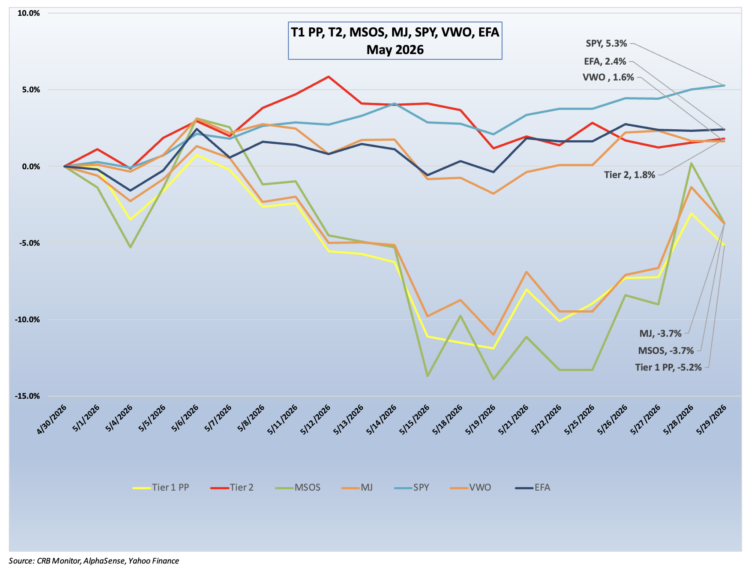
The CRB Monitor equally-weighted basket of top Pure Play Tier 1 CRBs closed out May with a return of -5.2%. This portfolio is an equally-weighted basket of the largest pure play Ther 1 CRBs (representing both US plant-touching and non-US plant-touching MJ companies). The CRB Monitor equally-weighted basket of Tier 2 CRBs outperformed the Tier 1 CRB basket, posting a +1.8% return for May 2026, closing the large gap that persisted in late April. In August 2025 CRB Monitor published an update to our article on correlations of Pure Play Tier 1 and Tier 2 CRBs, which also analyzed the correlations of MSOs and Canadian operators. What we have observed historically is that these two groups tend to display high correlation (>0.50) in the long term, while their respective performance has a tendency to diverge in the short term. This can be due to (among other factors) the lag from the impact of market forces (in this case marijuana rescheduling) that affect their sources of revenue that are derived from the Tier 1 group. If this theory holds, investors would be expected to load up on Tier 2 CRBs in the short term and we would witness this gap narrow over time.
U.S. equities’ delivered storng returns in May 2026, with major indexes reaching new record highs as investors responded positively to robust corporate earnings, continued economic resilience, and most of all, accelerating investment in artificial intelligence technologies. The rally was led by technology, semiconductor, and software companies, which benefited from sustained enthusiasm surrounding AI infrastructure spending and strong earnings results. Companies such as Dell Technologies, semiconductor manufacturers, and other AI-related firms posted substantial gains, helping offset weakness in several non-technology sectors. Despite concerns over inflation, rising interest rates, and geopolitical tensions in the Middle East, investor sentiment appeared constructive (for now). The S&P 500, represented by the SPDR S&P 500 ETF Trust (NYSE Arca: SPY), posted a return of +5.3% for the month of May.
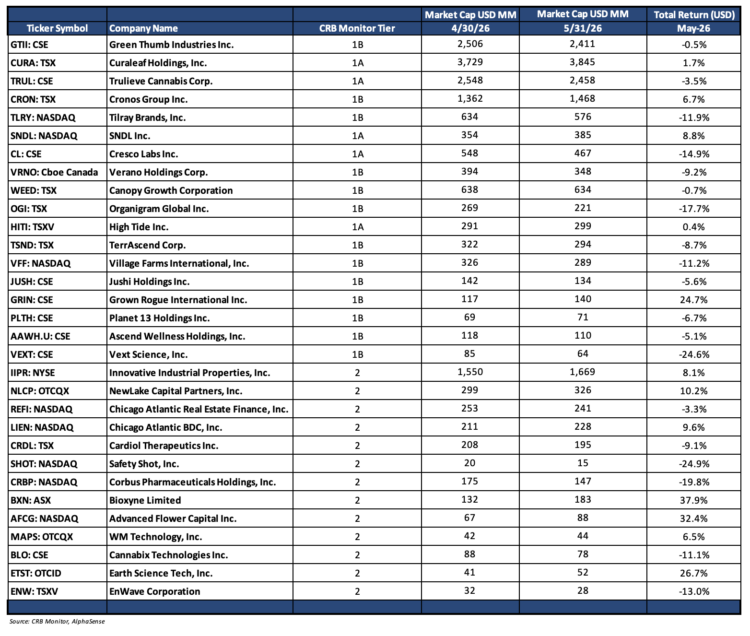
Largest Tier 1 Pure Play & Tier 2 CRBs by Market Cap – May 2026 Returns
CRB Monitor Tier 1
Performance across the Tier 1 CRB universe in May 2026 looked similar to many months in the past, which is generally driven by sentiment, wide spreads, and poor liquidity. In the MSO basket, Trulieve Cannabis Corp. (CSE: TRUL) (-3.5%), Tier 1B Cresco Labs Inc. (CSE: CL) (-14.9%), Tier 1Bs TerrAscend Corp. (TSX: TSND) (-9.2%) and Curaleaf Holdings, Inc. (CSE: CURA) (+1.7%) all benefitted from the news cycle. Similarly, Tier 1B Verano Holdings Corp. (CSE: VRNO) (-9.2%), and Green Thumb Industries Inc. (CSE: GTII) (-0.5%) responded well to May rescheduling revelations.
Companies in the Canadian CRB basket, which tend face a lighter impact from US cannabis reform-related news (either positive or negative) than MSOs, also had a nice May. Tier 1A SNDL, Inc. (Nasdaq: SNDL) (+8.8%) and Tier 1B CRB Canopy Growth Corporation (TSX: WEED) (-0.7%), Tier 1B craft beverage giant Tilray Brands, Inc. (Nasdaq: TLRY) (-11.9%), Tier 1B High Tide Inc. (TSXV: HITI) (+0.4%) and Tier 1B Cronos Group Inc. (TSX: CRON) (+6.7%) were all affected negatively by the lapse in global equities.
As we have stated regarding these two groups (MSOs and CADs), short-term performance has deviated between the CAD and the MSO baskets, but they tend to mean-revert over time and historical correlations are high. It is also worth mentioning that as an industry cannabis has fallen to the point where no company’s stock can even be regarded as a small capitalization stock; over the last few years they have all shrunk (some by more than 90%) to the point where they are considered micro-caps and consequently non-investable by most institutions from a policy perspective. For more detail on the MSO/CAD relationship, please see our August 2025 Chart of the Month on our CRB Monitor News website.
CRB Monitor Tier 2
An equally-weighted basket of the largest CRB Monitor Tier 2 companies outperformed the Tier 1 basket in May 2026 by 7.0%, posting a return of 1.8%. Historically the performance of these two portfolios (given their close business ties) has displayed high correlation (please see our recently-published August 2025 “Chart of the Month”), and we expect the returns of Tier 1 and Tier 2 CRBs to mean-revert over time. When the two baskets deviate from one another in the short term, the deviation could be a signal for investors to rebalance into (out of) the Tier 1 basket and out of (into) Tier 2’s given their direct revenue relationship. This is due to the fact that Tier 2 CRBs are direct suppliers of goods and services to (and derive their revenues from) Tier 1 CRBs. However, the precise moment when these two baskets mean revert is not easy to predict and the costs required to systematically rebalance these illiquid portfolios could eat up any expected material gains from even the best rebalance strategy. In other words, gaming these two baskets can lead to losses, so proceed with caution!
The performance of the largest CRB in the Tier 2 basket, well-known REIT Innovative Industrial Properties, Inc. (NYSE: IIPR) (CRBM Sector: Real Estate) (+8.1%) rebounded from a lackluster March. On May 4th IIPR reported its 1st quarter 2026 results which featured the following highlights:
- Total revenues of $69.0 million and net income attributable to common stockholders of $30.2 million, or $1.02 per diluted share ( all per share amounts in this press release are reported on a diluted basis unless otherwise noted).
- Adjusted funds from operations (“AFFO”) of $53.4 million, or $1.88 per share.
- Declared dividends to common stockholders totaling $1.90 per share. Since its inception, IIP has paid over $1.1 billion in common stock dividends to its stockholders.
Tier 2 REIT Advanced Flower Capital, Inc. (Nasdaq: AFCG) (CRBM Sector: Real Estate) (+32.4%) had a strong May, outperforming nearly all CRBs. On May 4th AFCG reported its 1st Quarter 2026 financial results (featuring net income of $4.8 million) with the following highlights and the statement from CEO Daniel Neville:
- GAAP net investment income (“NII”) for the quarter ended March 31, 2026, was $4.8 million, or $0.21 per basic weighted average share
- Net asset value per share as of March 31, 2026, was $7.90, as compared to $7.46 as of December 31, 2025
- GAAP net increase in net assets resulting from operations for the quarter ended March 31, 2026, was $11.4 million, or $0.49 per basic weighted average share
- Gross and net investment fundings were $80.9 million and $39.1 million, respectively
- Net debt-to-equity as of March 31, 2026 was 0.48x
“AFC delivered a strong first quarter with net investment income exceeding our quarterly dividend. Additionally, in our first quarter as a BDC, we saw an increase in investment fundings driven by our pipeline focused on the lower-middle market across various industries.”
Tier 2 technology company, WM Technology, Inc. (Nasdaq: MAPS) (+6.5%), operates Weedmaps, the leading online listings marketplace for cannabis consumers and businesses, and WM Business, the most comprehensive SaaS subscription offering sold to cannabis retailers and brands. On May 22nd, MAPS reported its 1st Quarter 2026 earnings, with the following chilling headlines:
- Revenues for the first quarter ended March 31, 2026 were $43.6 million as compared to $44.6 million in the prior year period. The decrease was primarily driven by continued softness across core markets, as challenging operating conditions for cannabis operators weighed on advertising spend.
- Average monthly paying clients(1) of 4,983 decreased from 5,179 in the prior year period, largely due to churn in more established markets, partially offset by new client acquisitions across certain developing markets.
- Average monthly revenues per paying client(2) increased to $2,914 from $2,871 in the prior year period, primarily reflecting a positive mix impact from churn among clients with below-average spend levels.
- Net income decreased to $1.7 million from $2.5 million in the prior year period.
- Adjusted EBITDA(3) decreased to $5.9 million from $10.1 million in the prior year period.
- Total shares outstanding across Class A and Class V Common Stock were 159.0 million as of March 31, 2026.
- Cash, cash equivalent and marketable securities increased to $57.0 million as of March 31, 2026, as compared to $53.3 million as of March 31, 2025.
CRB Monitor Securities Database Updates
CRB Monitor’s research team monitors the information cycle daily and maintains securities’ profiles to reflect the current state of the cannabis ecosystem. Here is a summary of the updates for May 2026:
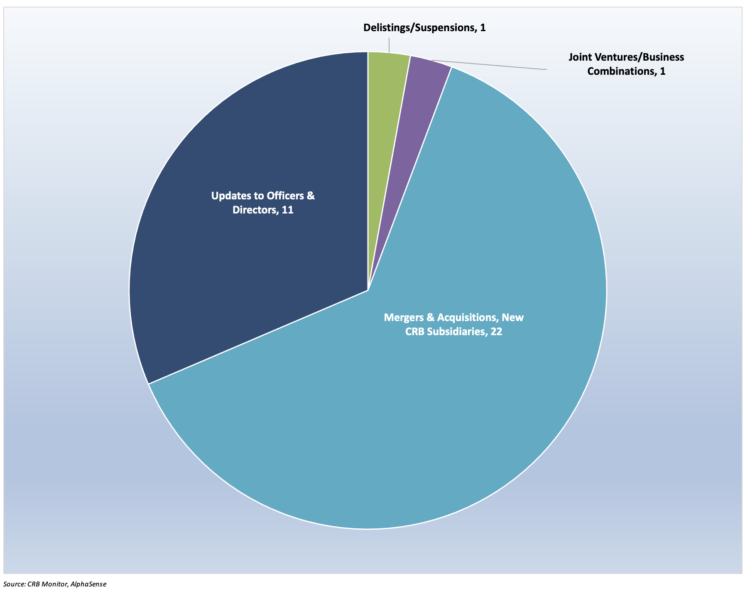
Cannabis Business Transaction News – May 2026
As we have for more than a decade, the CRB Monitor research team covers the cannabis business news cycle daily. Our goal is to remain up to date on all the relevant information vital to the ongoing breadth and accuracy of our data in the CRB Monitor securities database. And while the cannabis industry has faced major regulatory obstacles over those years, there has never been a shortage of news as licensed CRBs’ operations evolve to survive in a complicated business and regulatory environment.
On that note, here are some of the cannabis company news stories from May 2026:
Cresco Labs Provides Update on Texas License Preferred Awarded by Texas Department of Public Safety
Tier 1A MSO Cresco Labs Inc. announced an update regarding a preferred award for a Texas medical cannabis license issued through the Texas Department of Public Safety. The development would strengthen the company’s position in one of the nation’s largest limited-license medical cannabis markets if finalized. Investors are watching the licensing process closely because Texas expansion could provide a meaningful long-term growth opportunity. MSO Cresco Labs currently holds 76 active licenses in 12 states.
Trulieve to Open Medical Cannabis Dispensary in Bellview, Florida
Trulieve Cannabis Corp. announced plans to open a new medical cannabis dispensary in Bellview, Florida, further expanding its retail footprint in the state. The location is expected to improve patient access to the company’s medical cannabis products and services. Florida remains Trulieve’s largest operating market and a key contributor to revenue and profitability. Trulieve Cannabis Corp. currently holds 114 active licenses in 16 states and 3 Canadian provinces.
FLUENT Enters into Definitive Agreement to Sell Texas Business
Tier 1B MSO FLUENT Corp. entered into a definitive agreement to divest its Texas operations as part of a broader strategic realignment. The transaction is intended to streamline the company’s portfolio and improve its financial position. Management expects the sale to allow greater focus on core markets and growth initiatives. FLUENT Corp. currently holds 144 active licenses and has cannabis operations in 5 countries.
Curaleaf completes buyout of remaining stake in Germany’s Four 20 Pharma
Tier 1A MSO Curaleaf Holdings, Inc. completed the acquisition of the remaining ownership interest in Four 20 Pharma, making the German medical cannabis company a wholly owned subsidiary. The transaction increases Curaleaf’s exposure to Germany’s rapidly expanding medical cannabis market. Full ownership is expected to enhance operational integration and support future growth opportunities. Curaleaf Holdings operates in 6 countries and currently holds 115 active licenses in the U.S.
Tier 1B MSO Verano Holdings Corp. announced that it has submitted a DEA registration application following the federal government’s landmark marijuana rescheduling order. The application is designed to position the company to participate more directly in federally recognized cannabis activities if regulations permit. The move reflects growing industry efforts to capitalize on potential regulatory changes at the federal level. Verano currently holds licenses in states. Verano Holdings currently holds 82 active licenses and has cannabis operations in 16 states.
Vireo Growth Looks to Acquire FLUENT in All-Stock Transaction
Tier 1A MSO Vireo Growth Inc. proposed acquiring FLUENT through an all-stock transaction that would combine the two cannabis operators. The merger is intended to create a larger, more diversified company with a broader geographic footprint and enhanced scale. Management believes the combination could generate operational efficiencies and strengthen the company’s competitive position in key markets. Vireo Growth currently holds 213 active licenses (including 82 in the U.S.) and has cannabis operations in 5 countries.
Select CRB Business Transaction Highlights
| Company Name | Ticker Symbol | CRBM
Tier |
Event |
| Cresco Labs Inc. | CSE: CL | Tier 1A | Cresco Labs Provides Update on Texas License Previously Awarded by Texas Department of Public Safety |
| Trulieve Cannabis Corp. | CSE: TRUL | Tier 1A | Trulieve to Open Medical Cannabis Dispensary in Belleview, Florida |
| FLUENT Corp. | CSE: FNT.U | Tier 1B | FLUENT Enters into Definitive Agreement to sell Texas Business |
| Curaleaf Holdings, Inc. | CSE: CURA | Tier 1A | Curaleaf completes buyout of remaining stake in Germany’s Four 20 Pharma |
| Verano Holdings Corp. | CSE: VRNO | Tier 1B | Verano Submits DEA Registration Applications for State-Licensed Medical Cannabis Businesses Following Landmark Federal Rescheduling Order |
| Vireo Growth Inc. | CSE: VREO | Tier 1A | Vireo Growth Looks to Acquire FLUENT in All-Stock Transaction |
Officers/Directors Highlights
| Company Name | Ticker Symbol | CRBM Tier | Event |
| Curaleaf Holdings, Inc. | CSE: CURA | Tier 1A | Curaleaf Appoints Torsten Greif to Its Board of Directors |
| Planet 13 Holdings Inc. | CSE: PLTH | Tier 1B | Planet 13 Appoints Nancy Saitta and Leilani Bradford to Board of Directors |
| Doseology Sciences Inc. | CSE:MOOD | Tier 1B | Doseology Announces Extension to Closing of Private Placement and Resignation of Officer |
| iAnthus Capital Holdings, Inc. | CSE: IAN | Tier 1B | iAnthus Announces Appointment of Jason Ware as CFO |
Select Updates to CRB Monitor
| Name | Ticker Symbol | CRBM Action | CRBM Tier/Sector |
| Target Corporation | NYSE: TGT | Added | Tier 1A/ Licensed CRB |
| International Flavors & Fragrances Inc | NYSE: IFF | Moved to Watchlist | Tier 3/ CBD – Personal Products |
| Pure Harvest Corporate Group, Inc. | OTCID: PHCG | Moved to Watchlist | Tier 1A/ Multi-State Operator |
| Atlas Global Brands Inc. | CSE: ATL | Moved to Watchlist | Tier 1B/ Owner/Investor |
Cannabis News: Regulatory News Updates
We continue to closely follow the cannabis regulatory news cycle, which features developments from both state and federal levels of government as well as around the world. And as we have noted over the years, cannabis-related investment performance is primarily sentiment-driven and highly sensitive to news (rather than value or growth-based), particularly when the news comes from Washington. With that said, here are some of the May 2026 highlights:
Michigan Lab Accused of ‘Peak Shaving’
A Michigan cannabis testing laboratory has been accused of engaging in “peak shaving,” a practice in which test results may be manipulated to reduce the reported concentration of contaminants or alter product potency measurements. Regulators and industry stakeholders have expressed concern that such practices can undermine consumer safety and confidence in the legal cannabis market. The allegations have renewed calls for stronger oversight, standardized testing procedures, and increased transparency among licensed laboratories. If substantiated, the claims could result in enforcement actions and broader scrutiny of laboratory operations throughout the state.
Q1 2026 Cannabis Business Licensing Activity
Cannabis licensing activity remained active during the first quarter of 2026, with several states continuing to issue new cultivation, processing, retail, and distribution licenses. While some mature markets experienced slower growth due to market saturation, emerging markets contributed to overall expansion in the number of licensed operators. Regulators also focused on social equity initiatives and efforts to transition businesses from provisional to permanent licenses. The data suggests that the industry continues to grow, although at a more measured pace than during the initial legalization wave.
Delaware Court Grants Ch. 15 Protection to Cannabist
A Delaware court granted Chapter 15 bankruptcy protection to Cannabist, recognizing a foreign restructuring proceeding and allowing the company to coordinate its financial reorganization across jurisdictions. The decision provides legal protections for the company’s assets while restructuring efforts move forward. Management indicated that the process is intended to improve the balance sheet, reduce debt burdens, and preserve operations. The ruling highlights the complex legal challenges cannabis companies face when seeking restructuring relief due to the industry’s unique regulatory status.
New York’s CAURD Licensees Fight for Survival
Many of New York’s Conditional Adult-Use Retail Dispensary (CAURD) license holders continue to face significant financial and operational challenges as the state’s adult-use market develops. Delays in store openings, competition from illicit operators, and difficulties securing capital have created pressure on many early entrants. Licensees argue that regulatory hurdles have limited their ability to fully capitalize on the opportunities envisioned when the program launched. Industry participants are urging state officials to provide additional support and enforcement measures to help legal businesses compete effectively.
13 States Improve Regulatory Transparency
A recent assessment found that 13 states have improved transparency in their cannabis regulatory frameworks by making licensing, enforcement, and compliance information more accessible to the public. Enhanced transparency helps businesses better understand regulatory expectations and supports investor confidence in legal markets. Several states have adopted online dashboards, public reporting systems, and clearer guidance documents to improve communication with stakeholders. These reforms are viewed as positive steps toward creating more predictable and accountable cannabis regulatory environments.
New Mexico Border Town Rejects Cannabis Retail at Texas Lawmakers’ Request
The Sunland Park City Council in New Mexico rejected applications from two cannabis retailers seeking to open stores near the Texas border, despite city planning staff recommending approval. Opponents, including elected officials from neighboring El Paso, Texas, argued that the proposed locations could create public safety concerns by providing easy access to cannabis for residents of a state where marijuana remains illegal. The decision highlights the ongoing tension between legal cannabis markets and neighboring prohibition states, particularly in border communities that have become major destinations for out-of-state consumers.
Workers at Arizona Curaleaf Cannabis Store Finally Ratify Union Contract After Yearslong Fight
Employees at Curaleaf’s Midtown Phoenix dispensary unanimously ratified their first union contract, ending a four-year labor dispute that included legal challenges, regulatory complaints, and Arizona’s first cannabis worker strike. The three-year agreement provides guaranteed wage increases, protects existing benefits, and establishes formal grievance and disciplinary procedures. Labor advocates view the contract as a significant milestone for organized labor in Arizona’s cannabis industry and a potential model for future unionization efforts across the sector.
Leaders of the Marijuana Policy Project warned that Congress is unlikely to reverse legislation enacted in 2025 that significantly restricts hemp-derived THC products. Unless lawmakers intervene, the new federal definition of hemp is expected to take effect later this year, potentially removing many THC-containing hemp products—and even some CBD products—from the legal marketplace. Industry advocates argue the restrictions could have severe economic consequences for hemp farmers, manufacturers, and retailers, while supporters contend the changes are necessary to address concerns about intoxicating hemp products.
Wondering what a Tier 1, Tier 2 or Tier 3 CRB is?
See our seminal ACAMS Today white paper, Defining “Marijuana-Related Business,” and its update, Defining “Cannabis-Related Business”.
Wondering what a Tier 1, Tier 2 or Tier 3 DARB is?
See our seminal ACAMS Today white paper Defining ‘Digital Asset-related Business’ and Digital-Asset Related Businesses – What Financial Institutions Need to Know